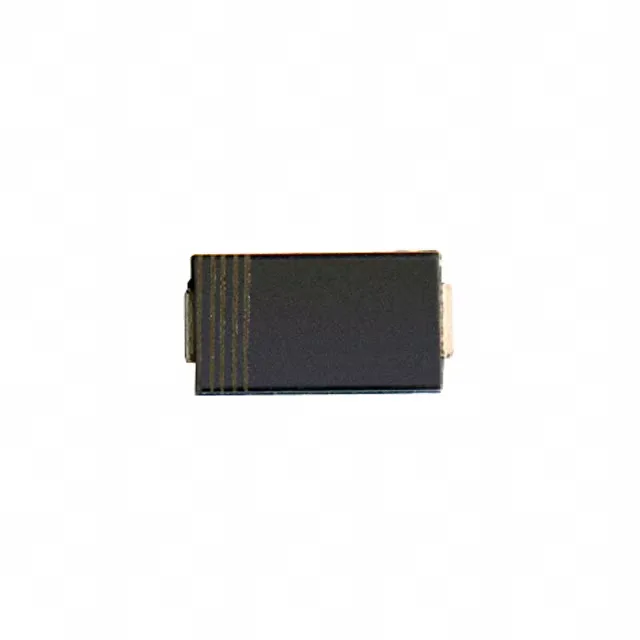
3.6 V regulation point and what it means on the bench
The SMAJ4729AE3/TR13 is a 3.6 V Zener diode in the standard DO-214AC (SMA) surface-mount package, rated for 2 W continuous power dissipation. That 3.6 V nominal is the knee voltage where it starts conducting in reverse breakdown — below that it blocks like a normal diode, above it clamps the rail to roughly 3.6 V plus the tolerance band. The 10 Ohm max impedance (Zzt) at the test current tells you how much the regulation voltage shifts with load current — lower impedance means tighter regulation. For a 3.6 V rail feeding a low-power MCU or a bias reference, that impedance is the number that governs how clean the rail stays under varying draw.
Temperature range and leakage — the reliability read
That 150°C ceiling means it survives under-hood automotive ambient or a cramped power supply without derating the power dissipation — but the 2 W max is at 25°C lead temperature; derate above that per the datasheet curve. Reverse leakage is specified at 100 µA max at 1 V reverse bias. In a battery-powered circuit where the Zener sits across a rail that is normally below breakdown, that leakage current is the standby draw the diode adds. At 3.6 V the leakage will be lower than the 1 V test point, but the spec gives you a worst-case floor for your quiescent budget.
Forward drop and package — board-fit details
Maximum forward voltage is 1.2 V at 200 mA forward current — this matters if the diode is ever forward-biased in the circuit (e.g., reverse-polarity protection). The DO-214AC footprint is standard: the cathode is marked by a band on the body, and the solder pad pattern matches the JEDEC outline for SMA diodes. Supplied in Tape & Reel (TR), which is the standard carrier for automated pick-and-place assembly. The reel quantity is set by the manufacturer; the package itself is reflow-compatible with standard lead-free profiles.
Active lifecycle — no obsolescence watch needed
Microchip lists this part as Active in production. No end-of-life notice, no last-time-buy window, no successor to track.