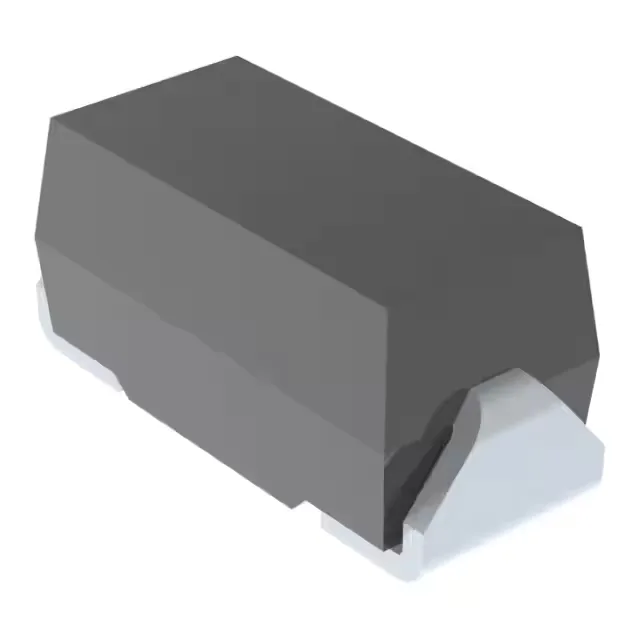
The SMAJ43AE3/TR13 is a Zener-type transient-voltage-suppression diode — it clamps overvoltage spikes on a 43V DC rail before they reach the downstream silicon. The reverse standoff voltage of 43V means the part sits across the rail and stays off until a transient pushes the line above that threshold; once the clamp triggers, the peak pulse power rating of 500W determines how much energy the part can absorb in a 10/1000µs surge before the junction gives out.
Clamping voltage and pulse current — the real derating numbers
The breakdown voltage range starts at 47.8V minimum, so the part begins conducting just above the 43V standoff. At the peak pulse current of 7.2A, the clamping voltage rises to 69.4V maximum — that 22V window between standoff and clamp is the margin the downstream regulator or capacitor bank has to survive. If the load's absolute maximum rating is below 69.4V, this TVS won't protect it; you need a lower-voltage clamp or a separate series element. The 500W rating is measured at 25°C — derate by about 0.6%/°C above that, so at 85°C ambient the effective peak pulse power drops to roughly 320W. That derating matters more than the headline number for a hot enclosure.
Active production — no obsolescence scramble
The unidirectional configuration means this is a single-diode clamp for a positive rail referenced to ground — not a bidirectional pair for AC lines or differential pairs. No power-line protection is built in; this is a signal- or low-power-rail clamp, not a mains surge suppressor.