What this TVS protects — and what it doesn't
The SMAJ16CE3/TR13: It clamps transients on a 16V nominal rail — the reverse standoff voltage — and starts breaking down at 17.8V min, so normal 16V supply ripple won't trigger it. The single bidirectional channel means it handles surges that swing positive or negative relative to ground, which is useful on AC-coupled signal lines or differential pairs where the common-mode voltage can shift.
Clamping voltage and current — the real-world margin
At the peak pulse current of 17.6A (10/1000µs), the voltage clamps to 28.8V max. That 28.8V ceiling is what the downstream IC sees during a surge — if the protected device's absolute-max rating is below that, you need a lower-clamp part or a second stage. The 500W rating is the product of clamp voltage and peak current; for shorter pulses the power capability goes up, but the datasheet derating curve is the final word.
Microchip lists the SMAJ16CE3/TR13 as Active.
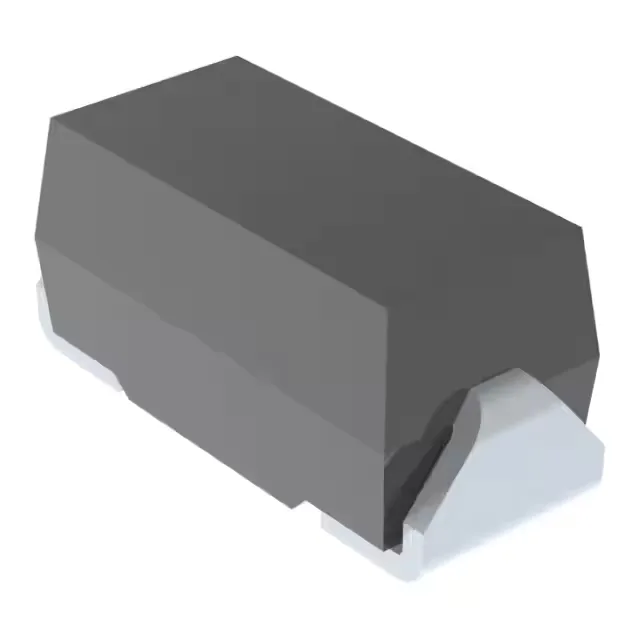
Surface-mount DO-214AC (SMA) — the same two-pad footprint used across the SMAJ series.