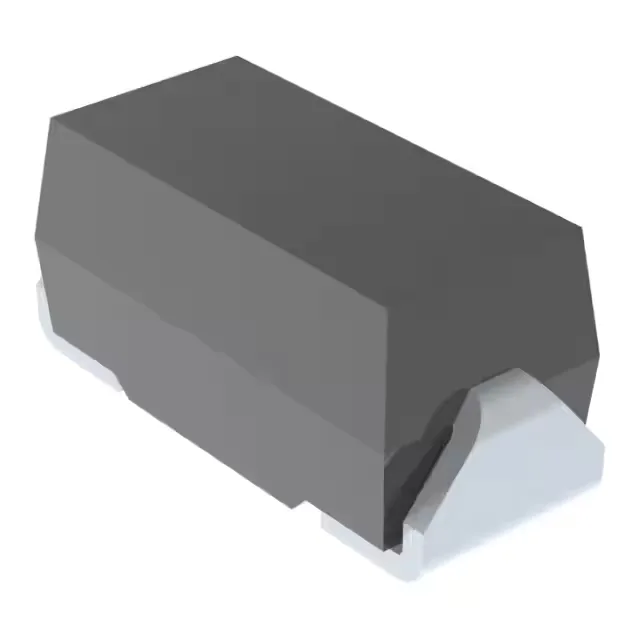
The 160 V standoff means this part will not conduct leakage current on a 160 V DC bus — it only clamps when the transient exceeds the breakdown threshold. The 500 W rating tells you the maximum energy it can absorb in a single surge; if your application sees repetitive or longer-duration transients, you need to derate or move to a higher-power part.
Bidirectional clamping, single channel
This is a bidirectional device with one protection channel. Bidirectional means the clamping characteristic is symmetrical — it protects against both positive and negative voltage spikes. The breakdown voltage is specified at a minimum of 178 V, and the clamping voltage at peak pulse current (1.7 A) is 287 V max. For a 160 V rail, the 287 V clamp gives a reasonable margin above the bus voltage, but the clamping voltage is not the same as the standoff — the downstream circuitry must survive the clamp level.
For a BOM line, this is a low-risk commitment — no near-term obsolescence watch needed.
DO-214AC (SMA) — a common footprint
The package is DO-214AC (SMA), a widely used surface-mount outline for TVS diodes and rectifiers. The SMA footprint is shared across many manufacturers, so if you have an existing SMA pad layout on your board, this part drops in without a layout change.