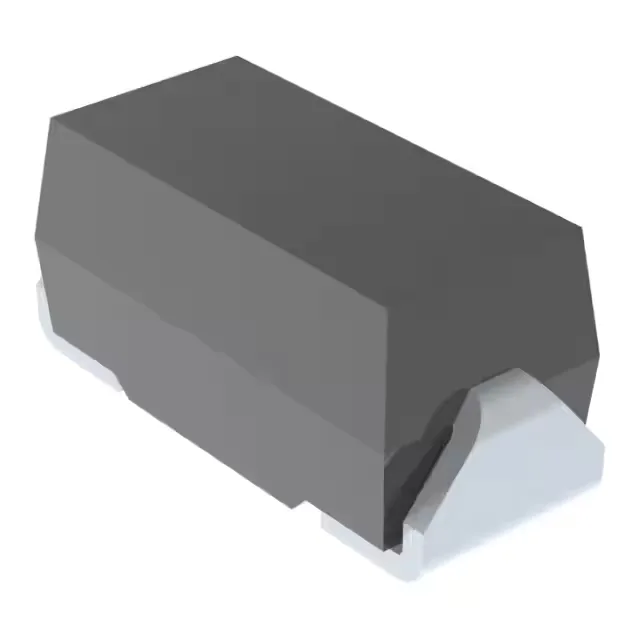
The SMAJ12CE3/TR13 is a bidirectional Zener TVS diode from Microchip Technology, rated for 500 W peak pulse power per the 10/1000 µs waveform. It clamps a 12 V nominal rail: reverse standoff at 12 V, breakdown at 13.3 V min, and clamping at 22 V max at the peak current of 22.7 A. Bidirectional means a single device protects both polarities — useful on AC-coupled lines or bipolar supplies where two unidirectional parts would double the footprint.
What the 500 W rating means for your BOM
Peak pulse power of 500 W is the energy-handling ceiling for a 10/1000 µs surge. For a 12 V rail, that translates to 22.7 A peak pulse current. If your application sees transients exceeding that amplitude — for example, a direct lightning surge on an outdoor sensor line — you need a higher-power part in the same SMAJ family (600 W or 1500 W). The 22 V clamping voltage at Ipp sets the maximum voltage the protected IC sees during the surge. A downstream component rated for 25 V minimum withstands this; if your rail runs a 12 V-to-3.3 V LDO, check its absolute max input rating against that 22 V clamp.
Microchip lists the SMAJ12CE3/TR13 as Active. No last-time-buy notice, no phase-out date.
Junction temperature range from -65°C to 150°C covers avionics cold-soak, outdoor telecom enclosures, and under-hood automotive ambient. The 150°C Tj max is the junction limit; derate peak pulse power above 25°C per the datasheet curve. DO-214AC (SMA) has a copper pad on the cathode tab — for a bidirectional device, both terminals are equivalent, but the pad area still influences thermal resistance. A 1 oz copper pour of at least 30 mm² per terminal keeps the junction temperature rise in check during repetitive surges.