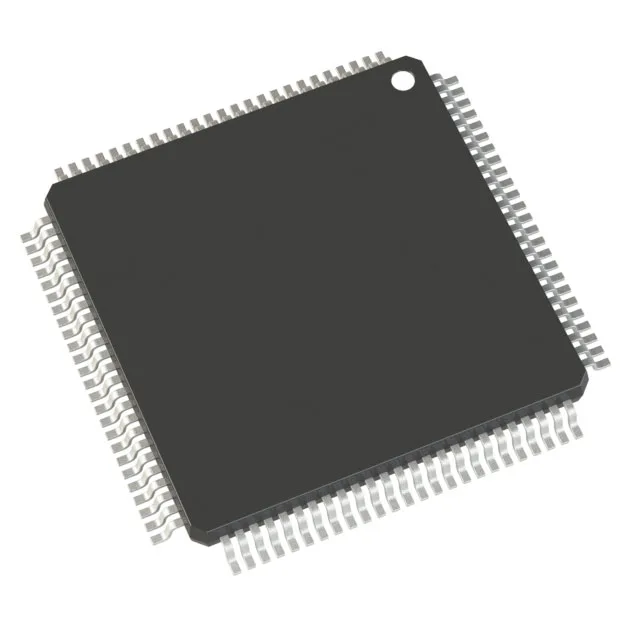
40 MHz MIPS32 M4K core — the entry-level 32-bit workhorse
The Microchip PIC32MX130F128L-I/PT is a 32-bit single-core MCU built around the MIPS32 M4K core, running at 40 MHz. This is the baseline density option in the PIC32MX1xx family — enough headroom for moderate control loops, protocol bridges, and sensor fusion without stepping up to the larger 256 KB or 512 KB Flash variants.
The 128 KB Flash is the smallest program memory option in the PIC32MX1xx family. It holds a FreeRTOS or MPLAB Harmony project with a TCP/IP stack and a couple of peripheral drivers, but you'll be watching the linker map. The 16 KB RAM (organized as 16K x 8) handles moderate packet buffers and a few large data arrays; if your application needs a full frame buffer or a large lookup table, consider the 256 KB Flash / 64 KB RAM siblings in the same package. The Flash is rated for the standard Microchip endurance — 10k erase/write cycles typical — which is fine for field-updatable firmware with wear leveling.
85 I/O in a 100-TQFP — routing density and peripheral allocation
With 85 I/O pins on a 100-pin TQFP (12x12 mm body), the PIC32MX130F128L-I/PT gives you a lot of signal breakout for the board area. That many I/O lines let you run a parallel LCD interface, a full memory bus, or multiple UART/SPI/I2C channels simultaneously without multiplexing. The 48-channel 10-bit ADC is mapped across multiple pins, so you can read a bank of analog sensors without an external mux. The trade-off is routing density on the PCB — the 0.5 mm pitch TQFP needs careful fanout, especially if you're using all 85 I/O. Plan for at least four-layer boards if you're running the ADC and high-speed peripherals concurrently.
Industrial temperature grade — -40 to 85 °C
It does not cover under-hood or downhole environments — those would need the -40 to 105 °C or 125 °C extended range parts.
For dual-sourcing resilience, the PIC32MX1xx family shares pin-compatibility across density options, so a move to the 256 KB or 512 KB Flash sibling is a BOM-line change, not a board respin.