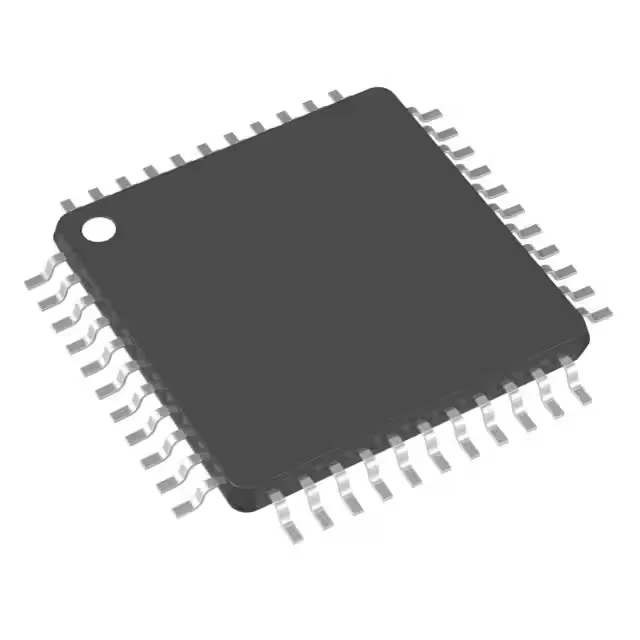
40 MIPs in a 44-pin TQFP — what that buys the control loop
The PIC24HJ64GP204-I/PT is a 16-bit MCU from Microchip's PIC® 24H family, rated for 40 MIPs throughput — that is the highest single-cycle instruction rate in the 16-bit PIC lineup, ahead of the 32 MHz ceiling on the PIC24F series. The core is a modified Harvard architecture with a 24-bit instruction word, so each MIP corresponds to one instruction per clock cycle at 40 MHz. For a motor-control loop running a 20 kHz PWM update with a 10-channel ADC scan, the 40 MIPs budget leaves headroom for the comms stack and fault-handling without dropping into wait states. The DMA peripheral offloads ADC result transfers directly to RAM, keeping the core free for the control algorithm.
Memory sizing and the firmware fit
On-chip Flash is 64 KB organised as 22K x 24-bit words — enough for a moderate control application with a fieldbus stack (CAN or Modbus over UART) and a bootloader. The 8 KB SRAM (8K x 8) is the tight spot: a full-frame buffer for a graphical display or a large data-log array will push the limit. For data-intensive tasks, the DMA and the PMP (parallel master port) can move blocks without core involvement.
Peripheral set for motor drive and industrial I/O
The PIC24HJ64GP204-I/PT carries a 13-channel ADC with 10-bit or 12-bit resolution, configurable for simultaneous sampling — useful for three-phase current sensing in a motor drive. The PWM module supports complementary outputs with dead-time insertion, and the QEI (quadrature encoder interface) is part of the peripheral set, though not listed in the brief connectivity summary. The 35 I/O lines in the 44-TQFP package leave about 20 usable after the ADC and oscillator pins are allocated, depending on the peripheral mix.
Package, supply, and temperature grade
ROHS3 compliant per the listing.
The PIC24H family has been in production for over a decade, and Microchip typically supports mature 16-bit lines with long product lifetimes. No official second-source cross-reference is published; the PIC24FV16KA304-I/PT is a lower-speed (32 MHz), lower-voltage (2.0 V) sibling in the same TQFP-44 footprint, but its peripheral set and memory map differ, so a drop-in replacement requires firmware and BOM validation.