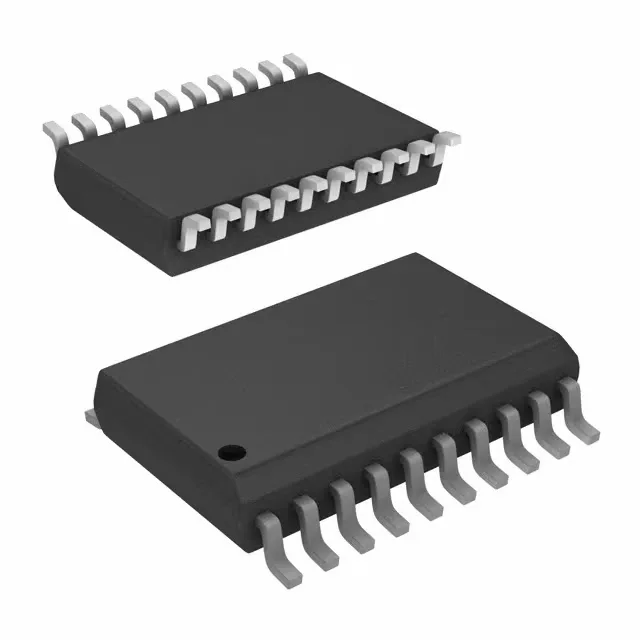
What this 8-bit PIC brings to a BOM
The Microchip PIC18LF13K50-I/SO is an 8-bit MCU from the PIC® XLP™ 18K family, clocked at 48 MHz with 8 KB Flash program memory, 512 bytes of RAM, and 256 bytes of EEPROM. It integrates a USB 2.0 interface alongside I²C, SPI, and UART/USART serial connectivity — a combination that lets a single-chip design handle both a PC connection and sensor/peripheral communication without an external bridge or UART-to-USB converter.
At 48 MHz the PIC18 core executes most single-cycle instructions at 12 MIPS (48 MHz / 4 clock cycles per instruction). That throughput is enough for USB polling, ADC conversions, and a control loop running in the 10–50 kHz range, but it is not a DSP-class part — if your application needs FFTs or PID at 100 kHz update rates, step up to a dsPIC or ARM Cortex-M.
USB on-chip — no external PHY needed
The PIC18LF13K50 includes a full-speed USB 2.0 module (12 Mbps) with an integrated transceiver. That saves a board position and about $0.30–0.50 per BOM compared to pairing a non-USB MCU with an FTDI or CP2102 bridge. The USB engine handles the packet-level protocol; the firmware stack (Microchip's USB framework or a lightweight CDC class) fits within the 8 KB Flash if you keep the application lean.
1.8 V operation — battery-friendly floor
The XLP (Extreme Low Power) technology keeps sleep-mode current in the nanoamp range — useful for battery-powered sensors that wake briefly, log a reading, and go back to sleep.
Industrial temperature grade — not for under-hood
It does not carry AEC-Q100 qualification, so it is not a candidate for engine-bay or transmission-control modules.
Microchip has not issued a last-time-buy notice or a PCN for this device.
20-SOIC package — layout notes
The 14 general-purpose I/O pins are multiplexed with the USB D+/D- lines, the ADC inputs, and the serial peripheral pins.