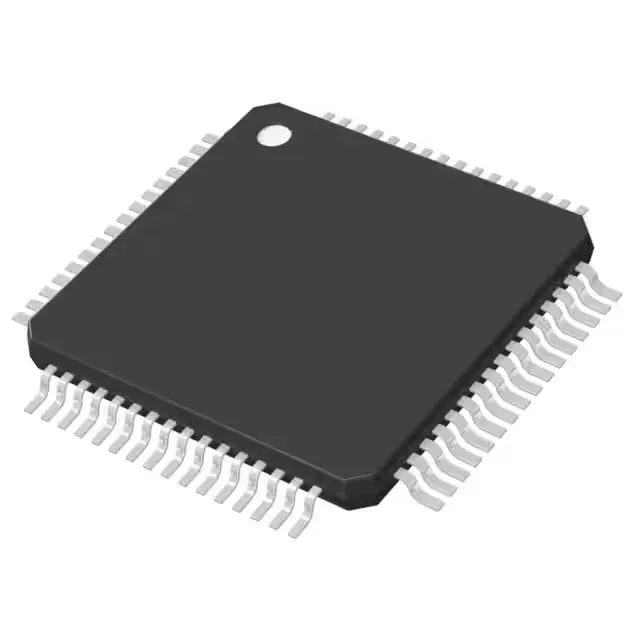
Microchip Technology PIC18F66J65-I/PT — Microcontrollers & Processors (MCU / MPU / DSP)

PIC18F66J65-I/PT Microchip 8-bit MCU, 96KB Flash, Ethernet

MPNPIC18F66J65-I/PT
Active

Microchip PIC® 18J series PIC18F66J65-I/PT, 8-bit MCU, 96KB Flash, 3808 x 8 RAM, 41.667MHz, Ethernet MAC, 39 I/O, 64-TQFP, -40°C to 85°C.

$7.2500Ref. price · indicative, final on quote
Packaging64-TQFP
RoHSROHS3 Compliant
SeriesPIC® 18J
Independent supplier — new & surplus stockAuthenticity-screened · ESD-safe packingListing updated Jul 2026

Specifications

PIC18F66J65-I/PT specifications
ParameterValue
SeriesPIC® 18J
MountingSurface Mount
Oscillator typeInternal
Program memory typeFLASH
Voltage - supply (Vcc (Vdd))2V ~ 3.6V
Operating temperature-40°C~85°C(TA)
Speed41.667MHz
PackageTray
RAM size3808 x 8
Core size8-Bit
PeripheralsBrown-out Detect/Reset, POR, PWM, WDT
ConnectivityEthernet, I²C, SPI, UART/USART
Number of i (O)39
Core processorPIC
Case64-TQFP
Data convertersA/D 11x10b
Program memory size96KB (48K x 16)

Product details

41.667 MHz 8-bit MCU with on-chip Ethernet — what the spec table does not tell you

The Microchip PIC18F66J65-I/PT is an 8-bit MCU from the PIC® 18J series that integrates a full Ethernet MAC on-die—unusual for an 8-bit core and the main reason this part exists.

Ethernet MAC on an 8-bit core — the real differentiator

The integrated Ethernet MAC is what sets this part apart from the bulk of the PIC18 lineup. It supports 10/100 Mbps operation with a dedicated DMA channel, offloading frame handling from the core so the 41.667 MHz clock is not consumed by bit-banging. This makes the PIC18F66J65-I/PT a fit for remote monitoring nodes, serial-to-Ethernet gateways, and industrial protocol converters where a full Linux-class MPU would be overkill.

It is ROHS3 compliant.

Peripheral set and I/O — what the 39 pins give you

Beyond Ethernet, the peripheral set includes I²C, SPI, and two UART/USART modules, plus an 11-channel 10-bit ADC, PWM outputs, a watchdog timer, brown-out detect, and power-on reset. With 39 I/O pins out of the 64-pin TQFP, roughly 25 pins remain after the Ethernet MAC and RMII interface are wired—enough for a parallel LCD, keypad matrix, or sensor array.

Second-source and cross-shop reality

There is no pin-compatible second source for this exact part. The closest functional peer in the Microchip portfolio is the PIC24FV16KA304-I/PT, a 16-bit MCU at 32 MHz with 16 KB Flash and no Ethernet—so it is a step down in networking capability and a different core architecture. If Ethernet is not required, the PIC24FJ256GA106-I/MR offers 256 KB Flash and 53 I/O in a 64-pin QFN, but again no on-chip MAC.

Frequently asked questions

Is PIC18F66J65-I/PT obsolete or still active?

It is qualified for new designs and production without LTB risk.

Does PIC18F66J65-I/PT support Ethernet?

Yes, it integrates a 10/100 Mbps Ethernet MAC on-die, which is the distinguishing feature of this 8-bit MCU. An external PHY is required for the physical interface.

What is the equivalent or alternative for PIC18F66J65-I/PT?

No pin-compatible second source exists. The PIC24FV16KA304-I/PT is a 16-bit alternative but lacks Ethernet. For designs requiring the on-chip MAC, the PIC18F66J65-I/PT is the only direct fit.