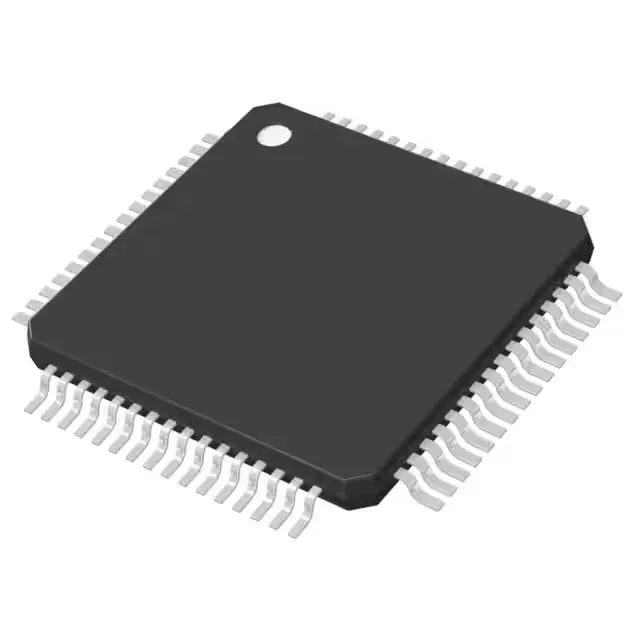
The base product number PIC18F6527 covers the full family; the -I/PT suffix specifies the industrial temperature grade and 64-TQFP package variant.
40 MHz in an 8-bit core — what it buys you
At 40 MHz the PIC18 core executes most single-cycle instructions, giving around 10 MIPS throughput. That is enough to service a UART at 115.2 kbps with bit-banged timing, run a PWM loop for motor control at 20 kHz, or poll a 12-channel 10-bit ADC without missing samples. The 48 KB Flash (24K x 16) holds a moderate firmware image — think a PID controller with Modbus RTU stack, or a keypad-and-LCD interface with data logging. The 3.8 KB RAM (3.8K x 8) is the practical limit for frame buffers and lookup tables; beyond that you are paging or using the 1 KB EEPROM for parameter storage.
5 V supply — legacy bus friendly
The HLVD (high/low-voltage detect) peripheral can generate an interrupt before the rail falls out of spec, giving the firmware time to save critical state.
54 I/O in a 64-TQFP — routing density
With 54 GPIOs brought out on a 0.5 mm pitch 10x10 mm TQFP, you get enough pins to drive a parallel LCD (8-bit data + control), read a matrix keypad, and still have serial lines for I²C EEPROM and SPI ADC. The 64-TQFP is a reflow-friendly package — no hidden balls, easy x-ray inspection. The 0.5 mm pitch demands a decent PCB fab but is well within standard capability; route the supply and ground pins first, then the high-speed oscillator traces.
Industrial temperature grade — where it lives
The internal oscillator is trimmed across temperature, but for timing-critical applications like CAN or precision PWM, an external crystal or resonator is advisable — the internal RC drifts more than a ceramic resonator over the full temperature swing.