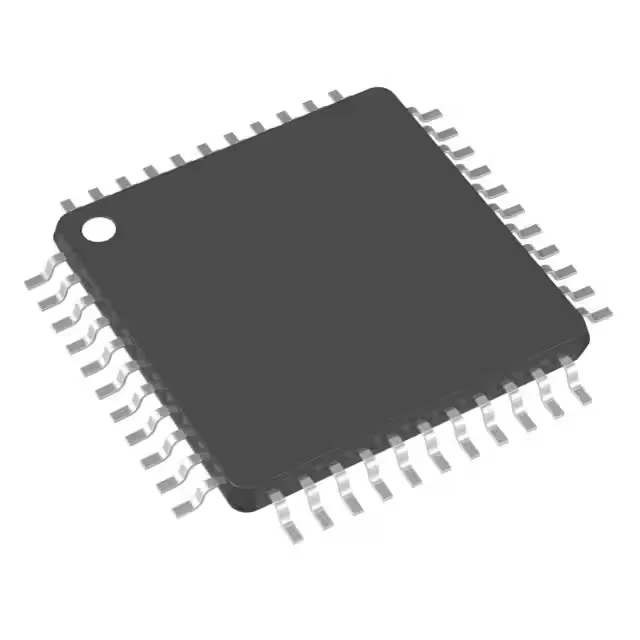
64 MHz 8-bit workhorse with XLP for battery-edge designs
The Microchip PIC18F46K40-I/PT is an 8-bit PIC MCU from the PIC® XLP™ 18K family, running at 64 MHz with 64 KB Flash, 3.6 KB RAM, and 1 KB EEPROM. The XLP (Extreme Low Power) technology keeps sleep-mode draw low enough for battery-powered edge nodes that wake periodically to log a sensor reading and go back to sleep.
At 64 MHz, this PIC executes one instruction per clock cycle for most operations, so the effective throughput is 64 MIPS. That is enough to run a PID loop at a few kHz, poll a UART at 1 Mbps, or drive a PWM motor controller with sub-microsecond resolution — all while the hardware peripherals handle the real-time events. The internal oscillator means no external crystal for the main clock, saving two pins and a couple of passives on the BOM. If you need precision timing for a CAN bus or a LIN node, the oscillator accuracy is adequate for most industrial LIN slave nodes without an external resonator.
Memory sizing for the firmware and data budget
64 KB Flash is the mid-range sweet spot for this family — enough for a bootloader plus a modest application stack with a USB HID or a simple Modbus RTU slave. The 3.6 KB RAM is tight for buffering large packets; if your application queues 1 KB Ethernet frames or stores a full display frame, you will need to move data to EEPROM or external serial RAM. The 1 KB EEPROM is useful for calibration constants, serial numbers, and fault logs that survive a firmware update — no separate external EEPROM part needed.
Microchip has not announced a last-time-buy or end-of-life for the PIC18F46K40-I/PT. The ROHS3 compliance covers EU and global regulatory requirements as they stand today.
Package and footprint — 44-TQFP with 36 usable I/O
The 36 I/O leaves 8 pins for power, ground, and the programming/debug interface (ICSP).
Analog and peripheral set for sensor fusion
With 35 analog input channels on the 10-bit ADC, you can monitor a dozen thermistors, a few potentiometers, and a current-sense resistor without external muxing. The single 5-bit DAC is coarse but enough for a bias voltage or a simple analog setpoint. The Brown-out Detect/Reset, Low-Voltage Detect, POR, PWM, and WDT peripherals cover the usual watchdog and power-supervision needs without external supervisory ICs — saves board area and BOM cost.