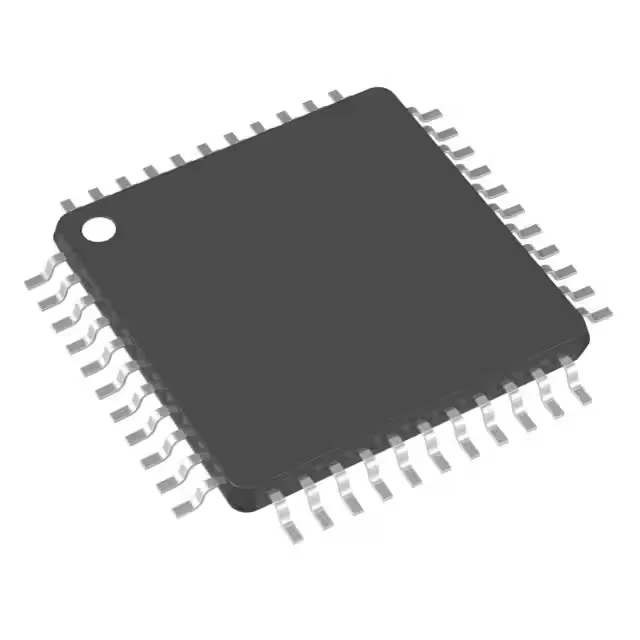
The Microchip PIC18F46J11-I/PT is an 8-bit MCU from the PIC® XLP™ 18J family, built around a PIC core running at 48 MHz. The XLP branding signals aggressive power management — this part is designed for applications where every microamp matters, such as battery-powered instrumentation, portable medical devices, and wireless sensor nodes.
The 48 MHz clock is the maximum operating frequency for this 8-bit PIC core. At this speed, the instruction cycle time is approximately 83 ns (Fosc/4). The Flash memory requires zero wait states at lower clock speeds; when you push past about 32 MHz, you need to configure one wait state in the device configuration bits, or the first branch after a flash read will fault. The 64 KB flash is organized as 32K x 16-bit words, matching the 16-bit instruction width of the PIC18 architecture.
The operating supply range of 2.15 V to 3.6 V covers two common battery chemistries: a single Li-Ion cell (nominal 3.6 V, end-of-discharge ~2.7 V) and two alkaline cells in series (3.0 V nominal, down to ~2.0 V). The 2.15 V minimum lets the MCU keep running deep into battery discharge, extracting more usable energy from the pack. The 3.6 V maximum is below the 5 V logic family, so level translation is needed if this MCU talks to legacy 5 V peripherals — though the 5 V-tolerant I/O pads on some PIC18 variants are not listed here, so plan for external translation or a voltage divider on inputs.
Industrial temperature grade and deployment environments
The 44-TQFP package is a surface-mount, gull-wing lead form with a 10x10 mm body and 0.8 mm pitch — standard for reflow assembly and visual inspection.
Peripheral set and I/O count for typical control applications
With 34 general-purpose I/O pins, you have enough headroom for a 16x2 character LCD in 4-bit mode (6 pins), a keypad matrix (8 pins), three serial buses (I²C, SPI, UART — 6 to 10 pins depending on handshaking), and a few digital inputs for limit switches or encoder pulses. The 13-channel 10-bit ADC samples at rates sufficient for low-speed sensor acquisition — temperature, pressure, or potentiometer feedback — but the 10-bit resolution means you need external amplification or a higher-resolution ADC for precision measurements below about 5 mV per count at a 3.3 V reference. The brown-out reset (BOR) and watchdog timer (WDT) peripherals are standard for fail-safe operation in unattended equipment.
The base product number PIC18F46 covers a family of density and package variants sharing the same core and peripheral set, so a pin-compatible migration to a sibling with more memory or a different package is possible without a PCB spin.