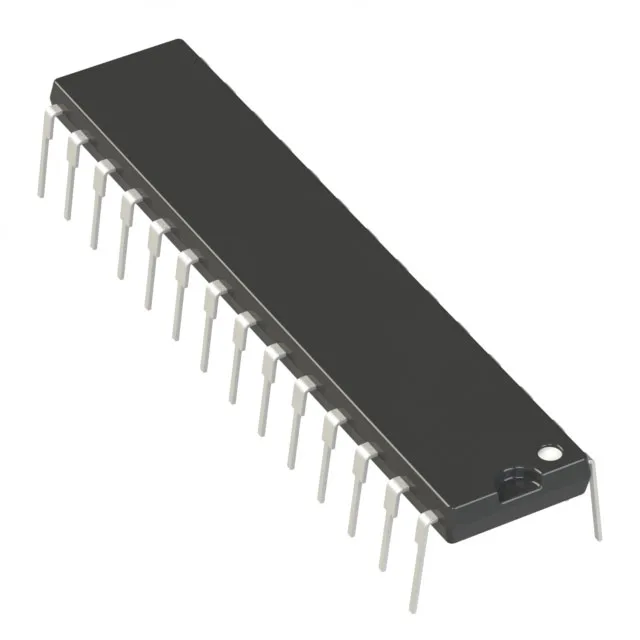
64 MHz 8-bit PIC with CAN — a fit for distributed control nodes
It comes in a through-hole 28-DIP (0.300", 7.62 mm) package, also designated 28-SPDIP, with 25 I/O lines. The 64 MHz core speed gives it enough headroom for real-time PWM and DMA-driven data movement without stepping up to a larger architecture.
CANbus on a DIP — where the 18F-Q83 fits the BOM
The CANbus peripheral is the standout feature here. Most 8-bit PICs in a DIP package do not carry CAN; you usually have to move to a 16-bit PIC24 or a 32-bit PIC32 to get it. This part puts a CAN 2.0 node into a 28-pin through-hole footprint, which matters for designs that need a low-cost, easily reworkable controller on a distributed bus — think sensor pods, actuator interfaces, or auxiliary ECUs where the MCU sits on a separate board or a serviceable module. The 25 I/O lines are enough for a handful of digital inputs, PWM outputs, and a local display or keypad, while the 12-bit ADC handles analog feedback from the plant.
The through-hole package also avoids the supply constraints that sometimes hit high-density BGA or QFN variants during allocation cycles.
Supply voltage and temperature — industrial range, wide rail
That is the standard for factory-floor electronics, outdoor telecom cabinets, and under-hood auxiliary modules that are not directly on the engine block.