64 MHz 8-bit core with 64 KB Flash — what that buys you
The 64 MHz speed lets it handle tight control loops, such as sensor readout at 10+ kHz sample rates, where a slower 8-bit would struggle. The 64 KB Flash is sized for moderately complex firmware — think motor commutation logic with a UART bootloader and a modest lookup table — not the 256+ KB tiers of the PIC24 or dsPIC families.
Mixed-signal on board: 24-channel 12-bit ADC and dual DACs
A 24-channel 12-bit SAR ADC and three DAC outputs (two 8-bit, one 10-bit) are integrated, which saves board space and BOM cost in applications like industrial sensor interfaces or basic closed-loop control. The 12-bit resolution gives you about 1 mV per LSB at a 3.3 V reference — adequate for monitoring supply rails or thermistor inputs without an external ADC. The DACs can bias op-amp inputs or generate analog setpoints.
The 125°C rating suits under-hood engine bay, outdoor solar inverters, or factory automation enclosures where ambient can climb above 85°C. The 'E' suffix is often the differentiator between a part that survives a hot reflow cycle and one that drifts after a few years.
Supply range from 1.8V to 5.5V means this MCU can run directly from a 3.6V Li-ion cell, a 5V USB rail, or a 3.3V regulated supply without a level translator. The wide range also simplifies dual-voltage designs where a 5V sensor feeds into the MCU's I/O.
Connectivity and I/O count
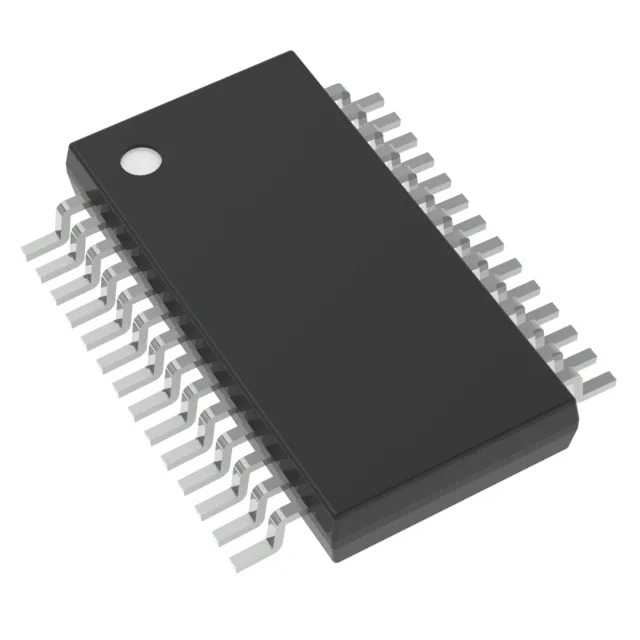
With 26 I/O lines and I²C, SPI, UART/USART plus FIFO buffering, this part can handle a mix of serial peripherals — say an I²C temperature sensor, an SPI flash for logging, and a UART debug console — without multiplexing. The 28-pin SSOP package (5.3 mm body width) keeps the footprint small for space-constrained PCBs.
There is no end-of-life notice (EOL) or last-time-buy (LTB) window in effect. For production planning, this means you can commit this part to a BOM without near-term obsolescence risk. If you are evaluating a design, the '-E/SS' variant is the one to spec for extended temperature; the '-I/SS' (industrial 85°C) is a cost-reduction option if your thermal budget allows.