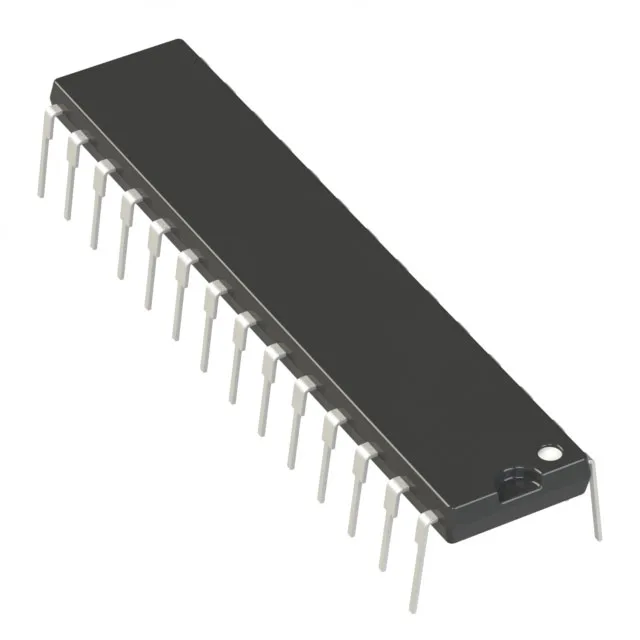
Microchip Technology PIC18F258-I/SP — Microcontrollers & Processors (MCU / MPU / DSP)

PIC18F258-I/SP Microchip 8-bit MCU, 40 MHz, 32 KB Flash, CAN

MPNPIC18F258-I/SP
Active

Microchip PIC® 18F PIC18F258-I/SP, 8-bit MCU, 40 MHz, 32KB Flash, 1.5K x 8 RAM, 256 x 8 EEPROM, 22 I/O, CANbus, I2C, SPI, UART/USART, -40°C to 85°C, 28-SPDIP.

$8.9800Ref. price · indicative, final on quote
Packaging28-DIP (0.300", 7.62mm)
RoHSROHS3 Compliant
SeriesPIC® 18F
Independent supplier — new & surplus stockAuthenticity-screened · ESD-safe packingListing updated Jul 2026

Specifications

PIC18F258-I/SP specifications
ParameterValue
SeriesPIC® 18F
MountingThrough Hole
Oscillator typeExternal
Program memory typeFLASH
Voltage - supply (Vcc (Vdd))4.2V ~ 5.5V
Operating temperature-40°C ~ 85°C (TA)
Speed40MHz
PackageTube
RAM size1.5K x 8
Core size8-Bit
EEPROM size256 x 8
PeripheralsBrown-out Detect/Reset, LVD, POR, PWM, WDT
ConnectivityCANbus, I2C, SPI, UART/USART
Number of i (O)22
Core processorPIC
Case28-DIP (0.300\", 7.62mm)
Data convertersA/D 5x10b
Program memory size32KB (16K x 16)

Product details

Through-hole 8-bit MCU with CAN — still a solid choice for industrial control

It comes in a 28-pin SPDIP through-hole package, so it's the kind of part you can socket or wave-solder into a board that sees vibration or field servicing.

CAN bus is the headline differentiator

This MCU includes a CAN 2.0B controller — a rare feature in an 8-bit DIP part. The same silicon also handles I2C, SPI, and UART/USART for local sensor or display links.

At 40 MHz the PIC18 core executes most single-cycle instructions at 10 MIPS. That's enough for real-time CAN message handling, PWM generation (the part has a PWM peripheral), and moderate sensor fusion. The external oscillator requirement means you'll need a crystal or resonator on the OSC pins — no internal RC for the main clock at this speed.

No last-time-buy clock ticking.

Through-hole package — old-school but repairable

That's a plus for prototype breadboarding, socketed firmware development, or field rework — you can swap it with a desoldering tool and a steady hand. The 22 I/O lines are brought out to the DIP pins, so layout is straightforward on a two-layer board.

This part runs on a 5 V nominal supply (4.2 V to 5.5 V range), so it fits legacy 5 V logic buses and industrial sensors directly. No level shifting needed for most 5 V peripherals.

Frequently asked questions

Does the PIC18F258-I/SP have CAN bus support?

Yes, it includes a CAN 2.0B controller integrated on-chip. That means you can connect directly to a CAN transceiver (like an MCP2551) without an external CAN controller IC.

What is the maximum clock speed of PIC18F258-I/SP?

The maximum clock speed is 40 MHz, which yields about 10 MIPS for single-cycle instructions on the PIC18 core.

Is PIC18F258-I/SP a direct replacement for PIC18F258?

The base product number is PIC18F258, so the PIC18F258-I/SP is the industrial-temperature, SPDIP-package variant of that base part. It should be a drop-in replacement for any design already using the PIC18F258 in the same package.

What programmer is required for PIC18F258-I/SP?

Microchip's standard programmers (PICkit 3/4/5, ICD 4/5, or the MPLAB Snap) all support the PIC18F family. The ICSP interface uses the PGD/PGC pins, which are available on the DIP package.