48 MHz 8-bit PIC with USB — what it brings to a BOM
The PIC18F24K50-I/ML: It integrates a full-speed USB 2.0 interface alongside I2C, SPI, and UART/USART serial connectivity, plus 22 general-purpose I/O and a 14-channel 10-bit ADC. This is the part to reach for when you need USB connectivity in a small 28-QFN footprint without moving to a 16-bit or 32-bit architecture.
Memory and peripheral headroom — the 16 KB / 2 KB / 256 B split
The 16 KB Flash (8K x 16 words) is sized for moderate firmware — USB HID or CDC class drivers, a command parser, and a control loop fit without squeezing. The 2 KB SRAM handles a couple of USB buffers and a modest data stack; if your application streams audio or logs large telemetry, watch the RAM budget. The 256-byte EEPROM is a genuine advantage: calibration constants, serial numbers, and configuration flags survive a firmware update because they live outside the Flash array. No external EEPROM needed for non-volatile parameters under 256 bytes.
USB on an 8-bit — what the peripheral set means
The USB 2.0 peripheral (full-speed, 12 Mbps) is the headline differentiator versus lower-end 8-bit PICs that lack it. It supports control, bulk, isochronous, and interrupt transfers, so you can implement HID, CDC (virtual COM port), or custom vendor-class devices without an external USB bridge chip. The remaining serial interfaces — I2C, SPI, and UART/USART — cover sensor readout, display communication, and debug logging. The 14-channel 10-bit ADC samples at rates adequate for slow analog signals (temperature, potentiometer, battery voltage); for higher-speed acquisition you would step up to a 12-bit or dedicated ADC part.
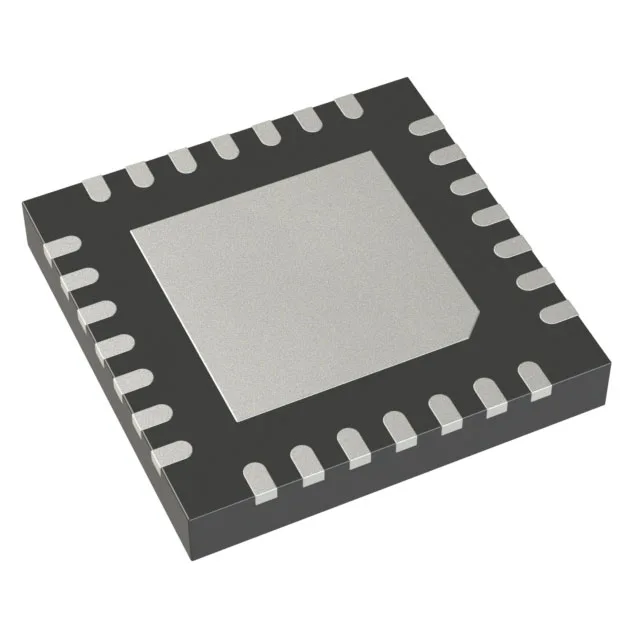
Package and thermal — 28-QFN exposed pad
The datasheet's recommended land pattern calls for a central pad aperture and via array; skipping the thermal connection limits continuous output drive and may cause junction temperature rise above 85°C in high-duty-cycle USB or PWM applications.
It is a current-production Microchip device suitable for new design-ins and production ramp. For dual-sourcing resilience, the PIC16LF1559-I/SS is a functional peer (same 8-bit PIC core, similar peripheral set) but differs in package, I/O count (17), and lacks USB — it is not a pin-compatible drop-in. The PIC24FJ256GA106-I/MR and PIC24FV16KA304-I/PT are 16-bit parts in different packages; they share the PIC ecosystem but require a different toolchain and memory model.