40 MHz 8-bit PIC — what the 18F1320 brings to a control BOM
It carries 8 KB of Flash program memory (4K x 16), 256 bytes of RAM, and a separate 256-byte EEPROM block — the EEPROM is useful for storing calibration constants or configuration data that survives power cycles without wearing the Flash. The part includes a 7-channel 10-bit ADC, a UART/USART for serial communication, and a set of standard peripherals: brown-out detect/reset, low-voltage detect, POR, PWM, and watchdog timer. The supply range of 4.2 V to 5.5 V places it firmly in the 5 V logic domain, common in industrial control panels, motor drives, and sensor interfaces where legacy 5 V rails are still the norm.
8 KB Flash, 256 B RAM — sizing the firmware envelope
The 8 KB Flash (4K x 16) is the program memory ceiling. For a typical control loop with a UART command parser, a few ADC readings, and PWM output, 8 KB is workable but tight — expect to write compact C or hand-tune critical sections in assembly if the application grows beyond basic I/O. The 256-byte RAM is the main constraint: stack depth, global variables, and buffers all share this space. The separate 256-byte EEPROM is a genuine advantage over parts that emulate EEPROM in Flash — it allows byte-level writes without sector erase cycles, and the endurance is typically 1M write/erase cycles, far exceeding Flash for frequently-updated parameters.
If your BOM runs on 3.3 V, this part will not work without a level shifter on the supply rail. The 5 V operation gives good noise immunity for industrial environments with long signal runs, and the I/O pins are 5 V-tolerant for interfacing with 5 V peripherals directly.
Industrial temperature grade and 18-SOIC package
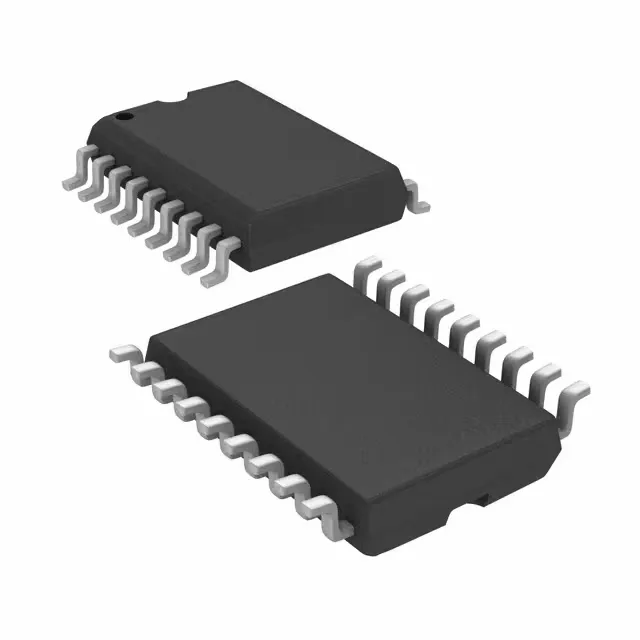
The 18-SOIC wide-body package (0.295-inch body width) has 1.27 mm pitch leads that are easy to hand-solder, inspect under a microscope, and rework with a hot-air station. The 18-SOIC footprint is common enough that PCB layout libraries are widely available.
The part is ROHS3 compliant. For a new design, this is a stable, in-production choice with no imminent supply discontinuity.