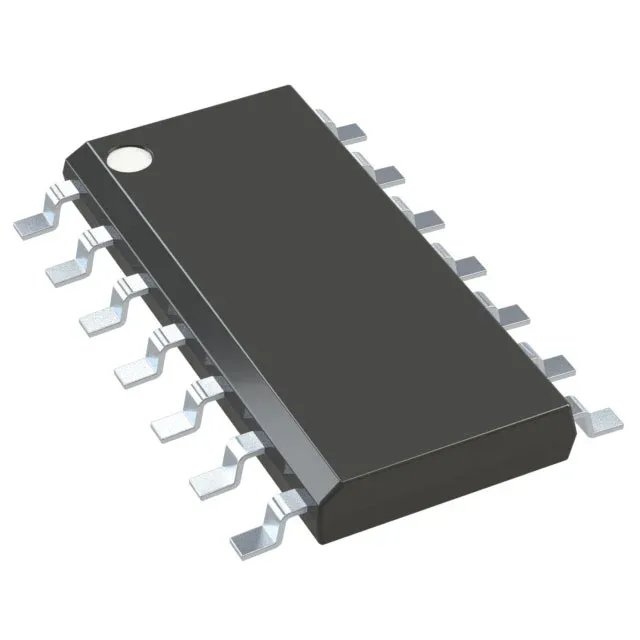
Microchip Technology PIC16LF15323T-I/SL — Microcontrollers & Processors (MCU / MPU / DSP)

PIC16LF15323T-I/SL 8-bit MCU, 32MHz, 3.5KB Flash, 14-SOIC

MPNPIC16LF15323T-I/SL
End of Life

Microchip PIC® XLP™ 16F series 8-bit MCU, PIC16LF15323T-I/SL, 32MHz core, 3.5KB (2K x 14) Flash, 256 x 8 RAM, 224 x 8 EEPROM, 1.8V-3.6V supply, -40°C to 85°C, 14-SOIC package.

$0.86Ref. price · indicative, final on quote
Packaging14-SOIC (0.154", 3.90mm Width)
RoHSROHS3 Compliant
SeriesPIC® XLP™ 16F
Independent supplier — new & surplus stockAuthenticity-screened · ESD-safe packingListing updated Jul 2026

Specifications

PIC16LF15323T-I/SL specifications
ParameterValue
SeriesPIC® XLP™ 16F
MountingSurface Mount
Oscillator typeInternal
Program memory typeFLASH
Voltage - supply (Vcc (Vdd))1.8V ~ 3.6V
Operating temperature-40°C ~ 85°C (TA)
Speed32MHz
PackageTape & Reel (TR); Cut Tape (CT)
RAM size256 x 8
Core size8-Bit
EEPROM size224 x 8
PeripheralsBrown-out Detect/Reset, POR, PWM, WDT
ConnectivityI²C, LINbus, SPI, UART/USART
Number of i (O)12
Core processorPIC
Case14-SOIC (0.154\", 3.90mm Width)
Data convertersA/D 11x10b; D/A 1x5b
Program memory size3.5KB (2K x 14)

Product details

What this 8-bit PIC brings to a low-power BOM

The Microchip PIC16LF15323T-I/SL is an 8-bit PIC MCU from the PIC® XLP™ 16F series, built for applications where every microamp matters. It runs at 32 MHz from an internal oscillator, operates from 1.8V to 3.6V, and carries 3.5KB of Flash program memory, 256 bytes of RAM, and 224 bytes of EEPROM. The 'LF' designation signals the low-voltage, low-power variant — the core runs down to 1.8V without a separate regulator, which simplifies single-cell Li-ion or two-alkaline designs. Typical applications span sensor nodes, handheld instruments, IoT edge controllers, and battery-monitoring subsystems where the XLP technology keeps sleep-mode draw minimal.

At 32 MHz the PIC16LF15323T-I/SL executes most single-cycle instructions, so a tight control loop — say, reading the ADC, applying a PID correction, and updating a PWM duty cycle — completes in a few microseconds. That is fast enough for motor commutation at a few kHz, digital power-supply loop closure, or real-time sensor polling without needing a DMA engine.

Memory sizing: 3.5KB Flash, 256B RAM, 224B EEPROM

The 3.5KB Flash (2K x 14 words) constrains firmware to compact, single-purpose routines — think state-machine-driven sensor interface, not a full RTOS. The 256-byte RAM handles a few dozen variables and a small stack; if your application needs a large lookup table or a serial buffer over 100 bytes, budget for external SPI SRAM or a larger PIC. The 224-byte EEPROM is useful for storing calibration constants, node ID, or configuration parameters that survive power cycles without wear-leveling concerns — endurance is typically 100k writes per byte, enough for infrequent updates over the product life.

Supply range and temperature: where it fits

Rated for 1.8V to 3.6V Vdd, the PIC16LF15323T-I/SL runs directly from a 3.6V Li-ion cell (down to its near-empty voltage) or from two alkaline cells in series.

Frequently asked questions

Does PIC16LF15323T-I/SL have a built-in ADC?

Yes, it integrates an 11-channel 10-bit ADC and a single 5-bit DAC, so external converters are not needed for basic analog sensing.

What is the difference between PIC16LF15323T-I/SL and PIC16LF15323-I/SL?

The only difference is the packaging format: the 'T' suffix denotes Tape & Reel (suitable for automated pick-and-place), while the non-T variant ships in tube or tray. The silicon, firmware, and all electrical ratings are identical.

Can I replace PIC16F15323 with PIC16LF15323T-I/SL?

Yes, the PIC16LF15323T-I/SL is the low-voltage (1.8V minimum) version of the PIC16F15323, which typically requires 2.3V minimum. The LF variant is a drop-in replacement if your supply rail is 1.8V to 3.6V; otherwise the F variant is fine for 2.3V to 5.5V systems.