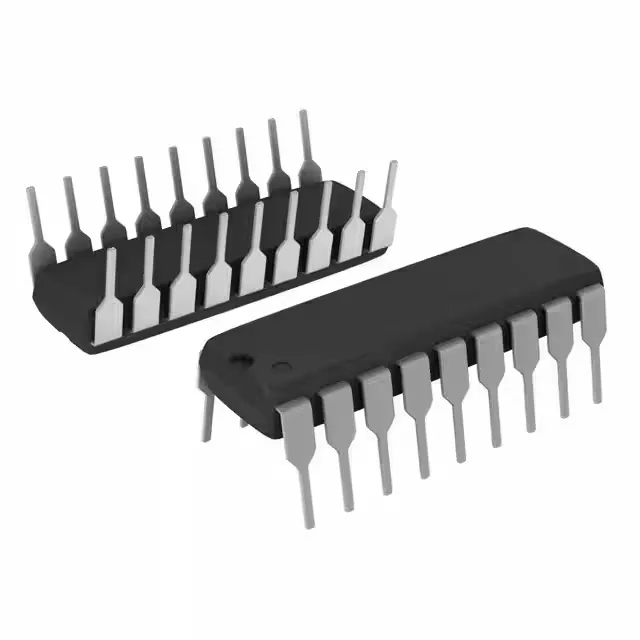
What this 8-bit PIC brings to a repair bench or new design
It runs at 20 MHz and carries 1.75 KB of Flash program memory, 68 bytes of RAM, and 64 bytes of EEPROM. With 13 general-purpose I/O lines and on-chip peripherals including Power-on Reset and a Watchdog Timer, it is a straightforward, no-frills controller for simple logic, timing, and sequencing tasks.
The 20 MHz external oscillator drives a 200 ns instruction cycle (the PIC16 architecture executes one instruction per four clock cycles). That is fast enough for switch debouncing, LED PWM at a few kilohertz, UART bit-banging up to 115200 baud, and reading a keypad or encoder. It is not a part for heavy number crunching or high-speed ADC sampling — the 8-bit ALU and 68-byte RAM limit the data payload. For a repair technician checking a dead board, the scorch mark on the DIP socket or a shorted Vdd pin is the first thing to look for; if the part itself failed, this is a drop-in replacement that keeps the original firmware intact.
Memory footprint and EEPROM endurance
The 1.75 KB Flash (1K x 14 words) holds a modest firmware image — think a few hundred lines of assembly or C for a simple state machine, not a multitasking RTOS. The 64 bytes of EEPROM is where you store calibration constants, serial numbers, or configuration flags that survive power cycles. The EEPROM is rated for 1 million erase/write cycles (per the PIC16F84A datasheet typical), so it handles frequent logging or trim updates without wear-leveling. The 68 bytes of RAM (registers plus general-purpose) is tight: every byte counts, so global variables and stack depth need careful budgeting during firmware bring-up.
It belongs inside an office appliance, a benchtop instrument, a consumer gadget, or an indoor control panel — not under the hood of a car or on an outdoor telecom pole.
Lifecycle and sourcing — still active, still available
For dual-sourcing resilience, the PIC16LF1559-I/SS is a surface-mount 8-bit alternative with similar peripheral set but a 1.8 V supply and internal oscillator — though it is not pin-compatible (SSOP-20 vs DIP-18), so a board respin is required.