What this 8-bit PIC does on the board
It packs 7 KB of Flash program memory (4K x 14 words) and 368 bytes of RAM, with 25 general-purpose I/O lines. On-chip peripherals include a 10-bit ADC with 11 channels, a PWM module, brown-out detect, power-on reset, and a watchdog timer.
Industrial temperature and 5V supply — where it fits
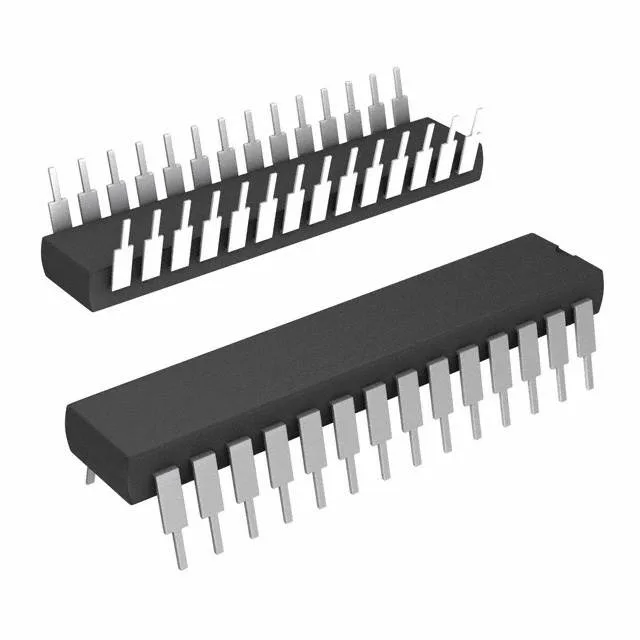
The 4V to 5.5V supply range means it interfaces directly with 5V logic and sensors without level shifters — a real BOM saver in industrial and automotive auxiliary systems. The 28-pin SPDIP through-hole package (0.300" wide) is a breadboard-friendly form factor that also survives vibration in harsh environments better than a fine-pitch SMD part.
20 MHz speed — what it buys you
At 20 MHz, the PIC16F737 executes most single-cycle instructions in 200 ns. That's enough headroom for a 115.2 kbps UART, a 400 kHz I²C bus, and a few hundred lines of control-loop code without worrying about timing closure. For a motor-feedback or sensor-read application, the 11-channel 10-bit ADC can sample at a rate that keeps up with a 1 kHz PWM update. If your algorithm needs more MIPS, you'd look at a 32 MHz part in the same family — but for the majority of 8-bit control tasks, 20 MHz is the sweet spot.
The 28-pin SPDIP is a through-hole part with 0.100" pitch — a socket-friendly package that lifts cleanly with a desoldering station. No hot air needed, no hidden pads. If you're prototyping or repairing a board, this is one of the easiest MCUs to swap without lifting a pad. The wide body (0.300") gives good thermal mass for hand-soldering, and the 0.025" square pins take a standard 0.100" header.
It's ROHS3 compliant. No LTB risk, no forced redesign.