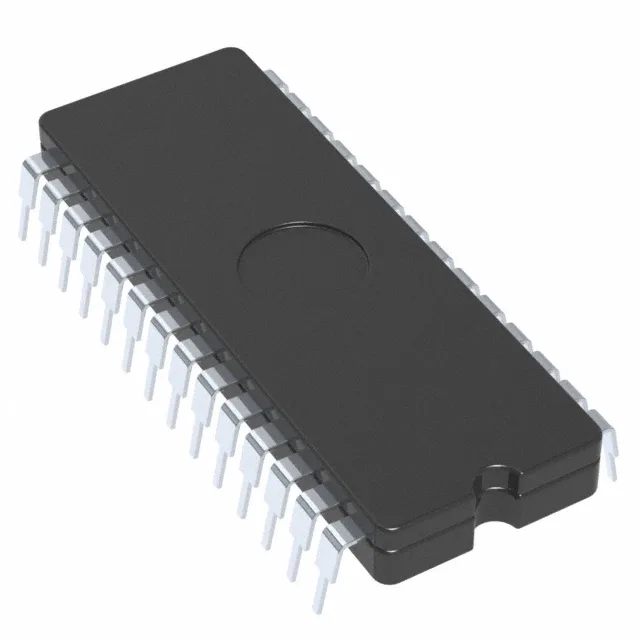
This is a baseline control MCU — no internal oscillator, no analog peripherals, no serial communication modules — aimed at simple logic sequencing, switch monitoring, and relay driving in cost-sensitive embedded systems.
20 MHz core — timing budget for simple control loops
At 20 MHz the 8-bit pipeline executes most instructions in a single cycle, giving a ~50 ns instruction time. That is fast enough for bit-banged I/O at tens of kHz, debouncing switches, or driving a simple PWM with external RC filtering — but tight for software UART at 115.2 kbaud or high-frequency sensor reads. The part runs from an external clock or resonator; there is no internal oscillator, so the BOM needs a crystal or ceramic resonator plus two caps.
The 2V to 5.5V supply span lets it run directly from a 3.6V Li-Ion cell, a 3.3V regulated rail, or a 5V logic supply — the same part covers battery-portable and line-powered designs. Brown-out reset and watchdog timer are on-chip, so a simple external supervisor may be optional.
Peripheral set: POR, WDT — no frills
The only on-chip peripherals are Power-on Reset and Watchdog Timer. There are no ADC, no PWM, no serial interface (UART/SPI/I²C), no comparators. If the application needs analog sensing or a serial bus, an external ADC or a software-bit-banged UART on the 20 GPIOs is required. For pure digital I/O control — reading limit switches, driving LEDs, toggling relays — this is a clean, low-cost fit.
Microchip lists the PIC16F57-I/P as Active.