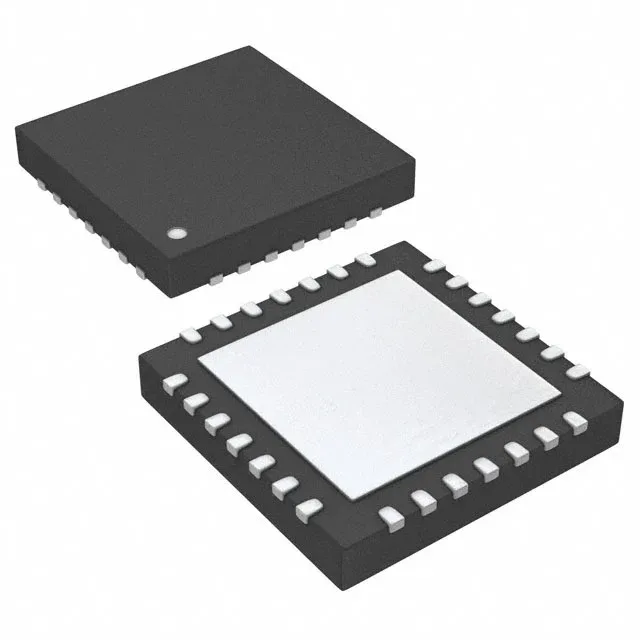
32 MHz PIC core with 14 KB Flash — what the memory budget buys you
The Microchip PIC16F18855-I/ML is an 8-bit MCU running at 32 MHz, with 14 KB of Flash program memory, 1 KB of SRAM, and 256 bytes of EEPROM. That Flash footprint is enough for a PID control loop with Modbus RTU stack, a sensor fusion algorithm reading 24 analog channels, or a LIN node in an automotive body module. The 1 KB SRAM is tight — you'll want to allocate carefully if you're buffering UART packets or holding a display frame buffer. The EEPROM is a separate non-volatile block for calibration constants or fault logs; no wear-leveling needed at 256 bytes.
24-channel ADC and 5-bit DAC — analog front-end integration
The 24-channel 10-bit ADC lets you read up to two dozen analog sensors without an external mux — think thermistor arrays, potentiometers, or current-sense amplifiers on a motor drive board. The single 5-bit DAC is coarse (32 steps), but it's enough for setting a comparator threshold, trimming a VCO, or generating a simple ramp. If you need higher resolution or a second DAC channel, you'd step up to a 16-bit PIC24F variant, but for basic analog output this keeps the BOM lean.
No NRND flags, no last-time-buy notices. The series is part of the PIC XLP 16F family with Functional Safety (FuSa) support, which suggests ongoing investment from Microchip.
28-QFN with exposed pad — thermal and layout notes
Without those vias, the junction temperature rises faster in a 85°C ambient under full load. The pad also acts as a ground return for the core and I/O — keep the inductance low.
Supply range and interfaces — design flexibility
The LINbus interface is a differentiator — it's not common on 8-bit MCUs in this price tier, and it makes the part a natural fit for automotive body electronics (door modules, seat controls, lighting) where LIN is the backbone.
It's suitable for outdoor telecom cabinets, factory floor sensors, engine-bay-adjacent modules (not directly under-hood), and any application where the board sees seasonal temperature swings.