It integrates a 17-channel 12-bit ADC and a 2-channel 8-bit DAC, plus serial connectivity covering I²C, LINbus, and SPI.
32 MHz core with on-chip analog — the so-what for a control loop
At 32 MHz the core executes one instruction per clock cycle (except branches), giving a throughput near 8 MIPS. That is enough for PID loops, keypad scanning, or LIN-bus node control, but not for heavy DSP or real-time audio. The 12-bit ADC samples up to 17 external channels — enough to monitor a small sensor array without an external mux. The two 8-bit DAC outputs can generate analog setpoints or bias voltages, trimming external components from the BOM.
Through-hole DIP — prototyping and production reality
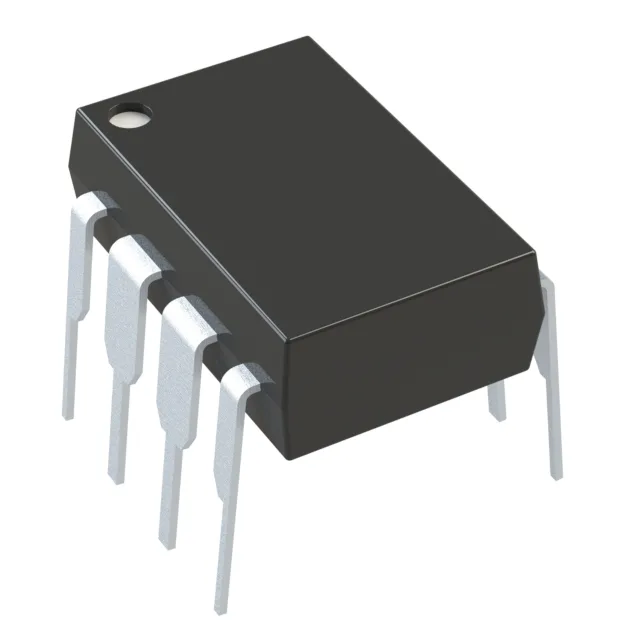
The 8-DIP (0.300" row spacing) is a breadboard-friendly footprint. It survives reflow if you hand-solder or wave-solder, but the real advantage is in low-volume builds where a socketed DIP lets you swap firmware or debug without desoldering. The 5 I/O pins (plus supply and ground) limit the peripheral count — plan for a shared I²C bus or a single SPI device if you need serial communication alongside the ADC inputs.