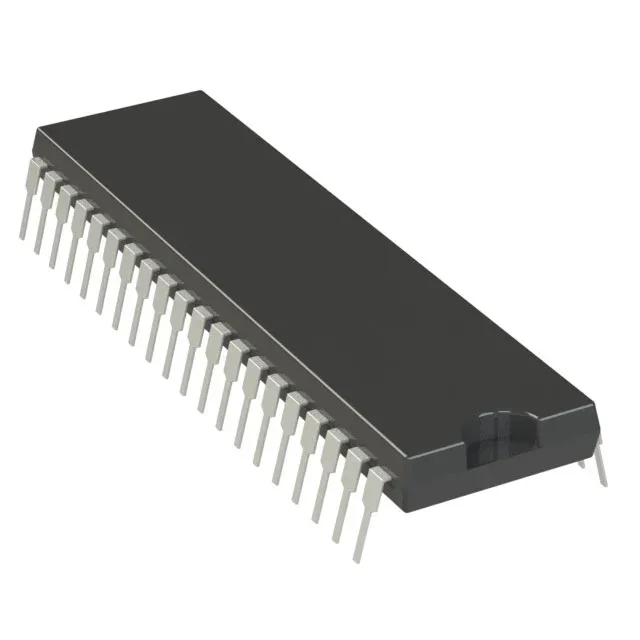
Why the 40-pin DIP matters in the field
This is a through-hole DIP (40-DIP, 0.600" wide) with a PDIP body. That means it goes into a socket or through-plated holes on a board — no hot air, no reflow profile, no risk of tombstoning. If you are swapping a failed controller on a production line or in a customer's cabinet, you can do it with a simple IC extractor and a soldering iron. The 35 I/O pins are all on 0.1" pitch, so even a protoboard layout is straightforward.
Memory and peripheral fit
14 KB of Flash is enough for moderate embedded control firmware — think motor commutation loops, sensor polling, communication stacks. The 1 KB RAM (1K x 8) handles a few dozen variables and a modest FIFO buffer; if your application needs large data tables or heavy buffering, you will want to step up to a part with more SRAM. The 10-bit ADC with 28 channels plus a separate 2-channel ADC covers analog inputs like thermistors, potentiometers, and current-sense resistors. The PWM module is there for LED dimming, motor speed control, or switch-mode power supply feedback.
Supply voltage and power rail design
The internal oscillator runs at 32 MHz without an external crystal, saving two pins and a few cents on the BOM. If you need tighter timing, the oscillator can be calibrated or an external clock can be fed in.