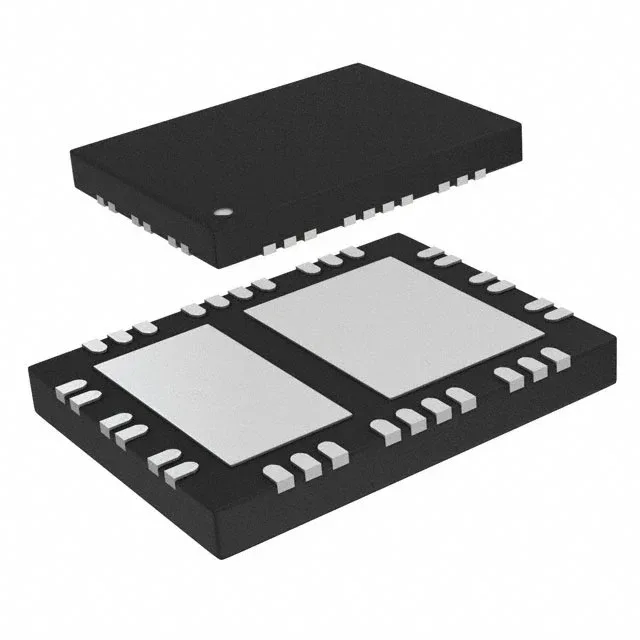
FET-based bridge rectifier for PoE — what it replaces
The Microchip PD70224ILQ-TR is a FET-based bridge rectifier designed specifically for Power over Ethernet (PoE) powered device (PD) interfaces. Instead of a conventional diode bridge with its 0.7–1.0 V per-diode drop, this part uses N-Channel MOSFETs as the bridge elements, which cuts the forward voltage drop significantly — important when you are trying to deliver the full 1.5 A output current to the load at the end of a long cable run. The internal switches are integrated, and the bridge topology uses a 2:1 input-to-output ratio, meaning it rectifies the differential pair from the Ethernet cable into a single DC rail. The 57 V maximum supply rating covers the 48–57 V range that PoE++ (IEEE 802.3bt) Type 4 PSEs can deliver at the source, with margin for transients on the cable. The 900 µA supply current is the quiescent draw of the gate-drive and control circuitry — negligible against the load current, but worth knowing for standby-power budgets in energy-efficient Ethernet designs.
1.5 A output — sizing the PoE PD rail
The 1.5 A maximum output current is the continuous DC rating after rectification. In a PoE application, this maps to roughly 25.5 W available at the PD assuming a 57 V rail and 85% efficiency through the bridge and downstream DC-DC — enough for a multi-port switch, a pan-tilt-zoom camera with heater, or a thin client. The actual current the Ethernet cable can deliver depends on the PSE class negotiation, but the PD70224ILQ-TR does not become the bottleneck below 1.5 A.
Package and thermal — 40-QFN with exposed pad
The part comes in a 40-TFQFN Exposed Pad package with 32 leads, supplier device package 40-QFN (6x8).
The 125 °C upper limit is the junction temperature, so the ambient ceiling depends on the thermal design; at 1.5 A output with good board layout, 85 °C ambient is achievable.