What the 5A rating means on a real board
The MIC29503WT delivers 5A continuous from an adjustable output rail between 1.25V and 25V — that is enough current to power a small FPGA core, a set of analog front-end rails, or a multi-radio module stack from a single regulator. Maximum dropout is 0.6V at that full 5A load, so the input rail needs to sit at least 600mV above the desired output voltage to stay in regulation. On a 5V output rail, the input must be 5.6V or higher — a 5V rail fed from a 5.0V supply will drop out under load.
Dropout headroom and input range
Input voltage maxes at 26V, which covers 24V industrial rails with 2V of margin for transients. The 0.6V dropout at 5A is specified as a maximum — typical dropout will be lower, but the headroom budget should use the max figure for worst-case design across temperature and lot variation.
Temperature grade and field environment
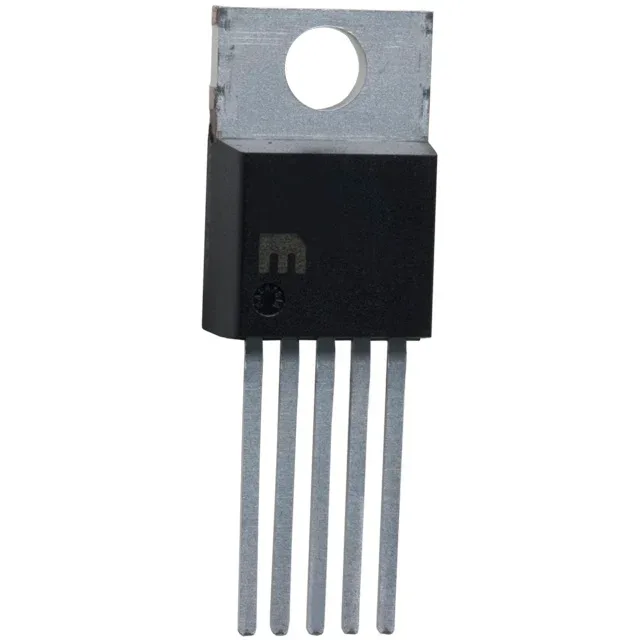
The TO-220-5 package bolts to a heatsink or chassis for thermal management at high current. Protection circuits include over-current, over-temperature, reverse polarity, and transient voltage — the regulator survives a swapped battery connection or a load-dump spike without external clamp diodes on the input.
Through-hole TO-220-5 package with five leads — input, output, ground, adjust, and a tab that is common with ground. The tab provides the primary thermal path; a heatsink or copper plane on the PCB is expected for sustained 5A operation. The adjust pin sets the output voltage with a resistor divider from output to ground. The output capacitor ESR and value affect stability — a 10µF tantalum or 22µF aluminum electrolytic with ESR between 0.1Ω and 1Ω is typical for this family.
No official second-source or pin-compatible alternative is listed from Microchip. The TO-220-5 footprint is unique to this regulator family; a board spin would be required to substitute a different LDO.