Active production — no redesign clock ticking
ROHS3 compliant per the listing, which matches the lead-free assembly requirements for most commercial and industrial builds.
Accuracy and temperature range — the fit decision
That ±2°C ceiling at the temperature extremes is the number to budget for in a thermal-shutdown or fan-control loop — if the system trip point is 105°C, the sensor could report 103°C or 107°C at the high end, so set the threshold with that window in mind. Both local and remote sensing channels cover the same -40°C to 125°C span, so a single part can monitor the die temperature and an external diode-connected transistor (e.g., a CPU or FPGA thermal diode) without a second IC.
Supply rail and bus interface
Operates from 3V to 3.6V — a tight 3.3V nominal rail. No 5V tolerance on the supply, so if the system runs a 5V bus, a local 3.3V LDO or a level shifter on the I²C/SMBus lines is required. The digital output is I²C/SMBus, which is the standard for board management controllers and BMCs.
Package and layout — the exposed paddle matters
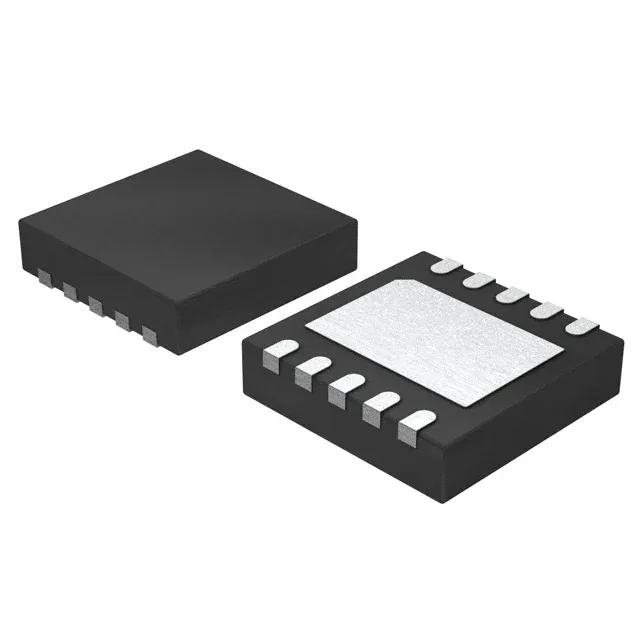
Housed in a 10-VFDFN with exposed pad, 3x3 mm body (supplier device package 10-VDFN). The perimeter pads are fine-pitch; a solder-paste stencil aperture that is 80% of the pad width avoids bridging during reflow.
Feature set for system integration
Includes one-shot conversion, programmable temperature limit, sleep mode, and standby mode. The one-shot feature lets the host take a single measurement then put the part back into low-power state — useful in battery-powered or duty-cycled systems where continuous conversion draws unnecessary current.