AEC-Q100 grade and the temperature envelope it buys you
The MCP9700T-H/LTVAO is an automotive-qualified analog temperature sensor from Microchip's MCP9700 family, carrying AEC-Q100 Grade 0 certification. That grade means the part is screened for -40°C to +150°C operation — the full under-hood temperature band — and passes the reliability stress tests (preconditioning, temperature cycling, HAST) required for automotive PPAP submissions. The 150°C maximum operating temperature is the junction limit, not a storage figure. In an engine-bay ECU that sees 125°C ambient on a hot day, the self-heating from the 5.5V supply rail at 12 µA typical quiescent adds less than 0.1°C to the die temperature, so the full 150°C headroom is available for the ambient.
Analog output scaling and the ADC interface decision
The wider tolerance at temperature extremes is dominated by the curvature correction circuit's residual non-linearity, not the bandgap reference drift. For a system that only needs ±3°C accuracy above 85°C, this part meets the spec without a calibration step.
Package and board integration for space-constrained designs
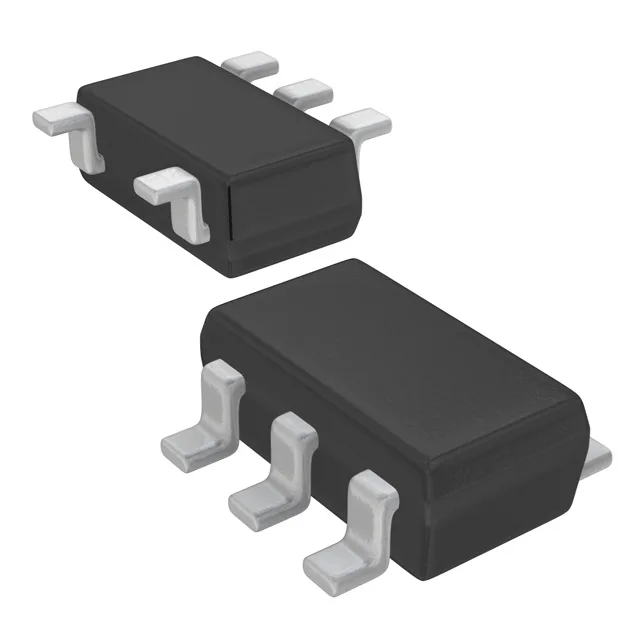
The 0.65 mm pin pitch is hand-solderable but the small pad geometry benefits from a solder stencil — the paste aperture should match the pad dimensions in the IPC-7351 footprint to avoid bridging between the output and supply pins. The Tape & Reel packaging (TR suffix) means the parts arrive on 7-inch or 13-inch reels with 3000 pieces per reel for the SC-70-5 format. This is the standard carrier for pick-and-place assembly; the reel quantity matches the typical automotive module build volume without excess handling.
No stock-holding claim — each order is confirmed against the manufacturer's current build cycle.