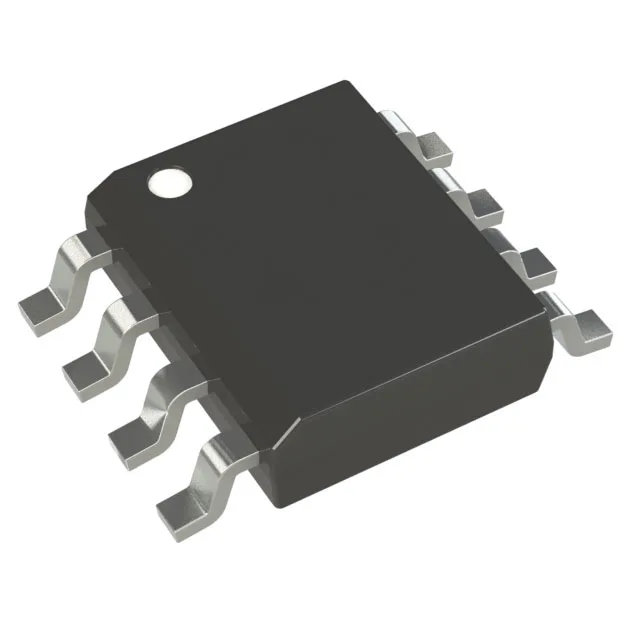
Precision DC measurement — the 2 µV offset story
The Microchip MCP6V28-E/SN is a single-channel zero-drift operational amplifier that auto-corrects its input offset voltage to a typical 2 µV, eliminating the need for external trimming or calibration routines in precision DC circuits. The zero-drift topology also suppresses 1/f noise, so the noise floor stays flat down to DC — useful for weigh scales or strain-gauge readouts that integrate over seconds. Rail-to-rail output swing lets it drive an ADC input full-scale on the same supply.
The part can sit on an engine bay PCB, an outdoor solar inverter control board, or a downhole sensor module that sees the full thermal cycle.
Slew rate and bandwidth — what they mean for signal fidelity
For faster signals, the MCP6V91 family (10 MHz, 9.5 V/µs) is a step up in speed while keeping the zero-drift topology.
Single-supply operation — yes, and here is the catch
The input common-mode range extends from the negative rail to within about 1 V of the positive rail — it is not a true rail-to-rail input, so for a 3.3 V single-supply circuit, the input must stay below roughly 2.3 V to maintain linearity. The output, however, swings rail-to-rail, so it can drive an ADC input full-scale. This combination is typical for zero-drift amplifiers and works well for ground-referenced signals like shunt currents or grounded thermocouples.