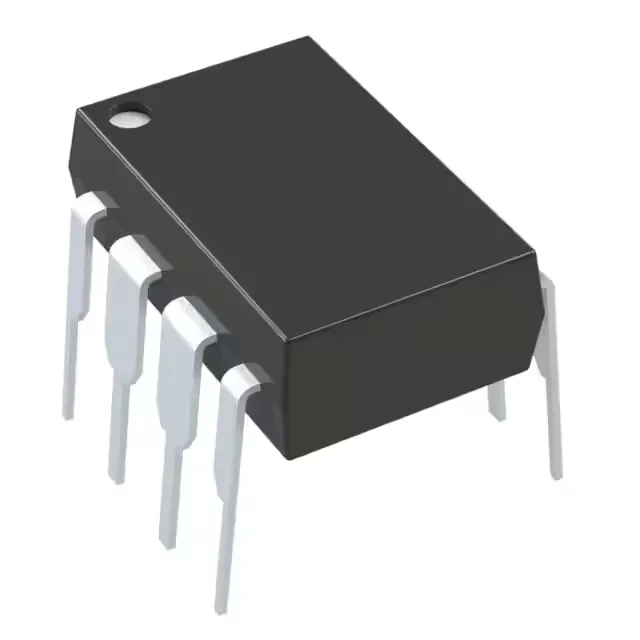
Dual op amp in a through-hole DIP — what the specs mean for your board
The 10 MHz gain-bandwidth product sets the small-signal bandwidth for a given closed-loop gain: at a gain of 10, expect about 1 MHz of usable bandwidth before the open-loop roll-off eats into phase margin. The 3 mV typical input offset voltage (not specified with a max in the listing) and 1 pA input bias current keep DC errors low for most precision analog paths, though if you need sub-millivolt offset across temperature, the MCP6V family of zero-drift amplifiers would be a better fit.
Active lifecycle and through-hole availability
The ROHS3 compliance covers current regulatory requirements for lead-free assembly. The through-hole PDIP-8 package is a standard, widely stocked form factor — not a niche or soon-to-be-discontinued package. For production lines that have migrated to surface-mount only, the single-channel MCP6291T-E/MS (MSOP-8) or dual-channel MCP6492T-E/MNY (TDFN-8) are surface-mount alternatives with similar parametric performance, though the MCP6492 has a 7.5 MHz GBWP and 6 V/µs slew rate.