Micropower dual op-amp for battery and sensor conditioning
300 kHz GBWP — what it buys you and what it costs
At 300 kHz gain-bandwidth, a closed-loop gain of 100 gives you a 3 kHz bandwidth — adequate for thermocouple amplification, strain-gauge conditioning, or battery-voltage monitoring. The 0.15 V/µs slew rate limits large-signal response; a 1 V step slews in about 6.7 µs, so don't plan on driving a fast PWM filter without phase lag. The trade-off is the 20 µA per-channel supply current: the MCP6232 keeps the battery alive for years in a low-duty-cycle system where a 1 mA op-amp would drain the cell in months.
Package and thermal: the exposed pad matters
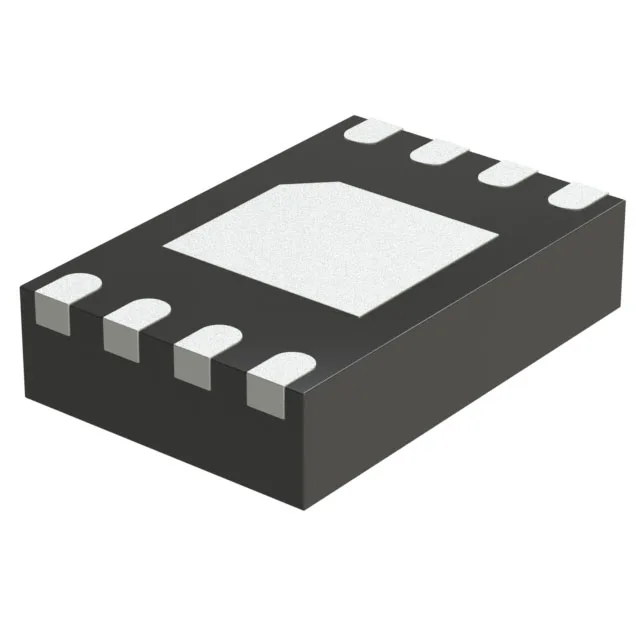
The 8-WFDFN with exposed pad (2x3 mm body, 8-TDFN supplier package) is a space-saver for dense boards, but the pad is the primary heat path. The pad is also the ground connection — the datasheet recommends connecting it to the negative supply rail.
The 1 pA typical input bias holds up across the temperature range, so high-impedance sensors (pH probes, photodiodes) don't drift with temperature. The 5 mV input offset is typical for a general-purpose CMOS op-amp — not precision-grade, but fine for 8-bit or 10-bit measurement chains.
For dual-sourcing or a speed upgrade, the MCP6272T-E/SN (2 MHz GBWP, 0.9 V/µs slew rate, 200 µA supply) is a pin-compatible alternative in an SOIC-8 package — same dual rail-to-rail topology, but hungrier on current.