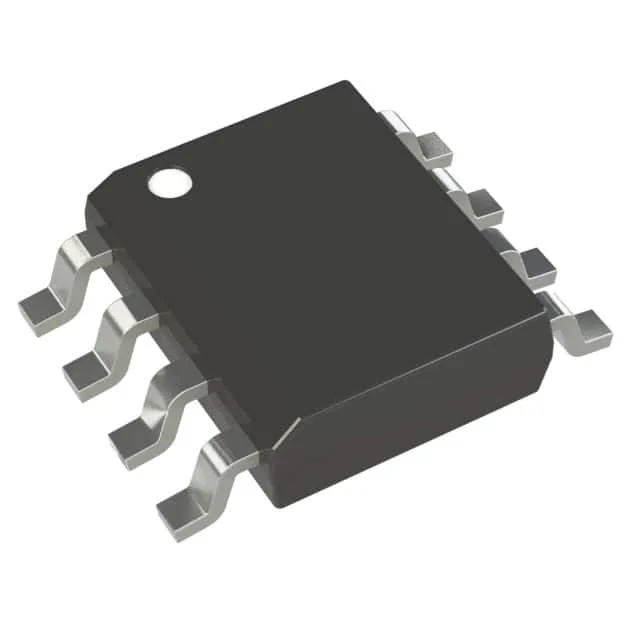
At 0.5 V/µs, the MCP6072 will cleanly reproduce a 1 V peak-to-peak sine wave up to roughly 80 kHz before visible distortion sets in. That is fine for thermocouple amplifiers, strain-gauge bridges, or 4-20 mA loop receivers, but it will round off edges on a 10 kHz square wave. The 1.2 MHz gain-bandwidth product confirms the same story: this is a low-frequency precision part, not a video-line driver or fast ADC buffer. If the board needs to pass 100 kHz signals, the MCP6272T-E/SN (2 MHz GBWP, 0.9 V/µs) is the step-up sibling to consider.
The 1.8 V minimum supply lets this op-amp run directly from a single Li-ion cell or a 1.8 V logic rail, while the 6 V maximum covers 5 V systems with margin. Input common-mode range is not rail-to-rail, so watch the datasheet limits if you are sensing near the positive rail at low supply.
The ROHS3 status covers the full substance restriction list, which simplifies compliance declarations for EU-market equipment.