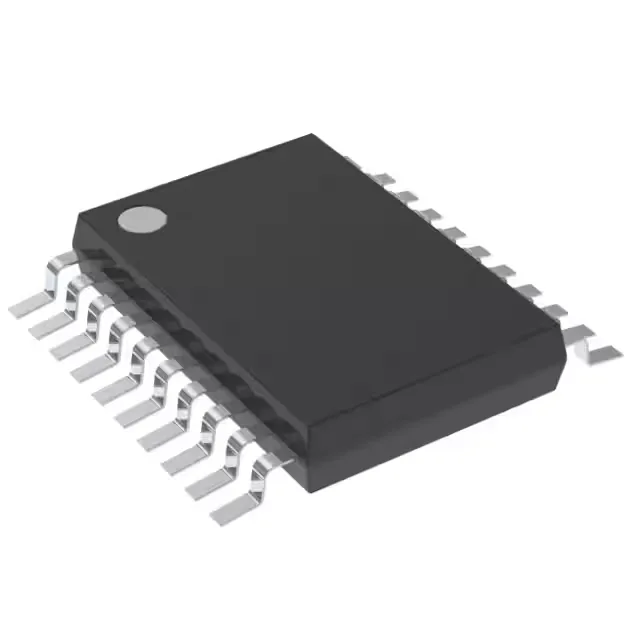
Quad 50 kΩ digital potentiometer with I²C interface
The MCP4451-503E/ST is a quad-channel digital potentiometer from Microchip, each channel offering 257 wiper taps across a 50 kΩ end-to-end resistance with a linear taper characteristic. The I²C interface with selectable address lets up to eight devices share the same two-wire bus, giving 32 independent potentiometer channels in a single address space.
Tap resolution and wiper performance
Each of the four potentiometer channels provides 257 wiper positions, which gives an 8-bit-plus-one resolution — about 0.39% of the full-scale resistance per step. The wiper resistance is 75 Ω typical, which adds a fixed series offset at the wiper terminal; this matters when the potentiometer is used in a voltage-divider configuration where the wiper resistance appears in series with the load. The temperature coefficient is 150 ppm/°C typical, meaning the 50 kΩ end-to-end resistance drifts about 7.5 Ω per 10°C change. For ratiometric applications like adjustable voltage references, this drift is acceptable; for absolute resistance accuracy, the ±20% tolerance on the end-to-end value is the dominant error term. The mute feature forces the wiper to the B terminal (zero output) via a logic pin, which is useful for audio muting or power-on sequencing where the wiper must start at a known state before the I²C bus initializes.
Housed in a 20-lead TSSOP package with 0.65 mm pitch, the MCP4451-503E/ST requires a standard surface-mount footprint. The 4.40 mm body width fits on two-layer boards with careful fan-out; the exposed pad (if present on this variant) should be connected to the ground plane for thermal management, though the part's 1.8V to 5.5V supply keeps dissipation low in most applications. The volatile memory type means the wiper position is lost when power is removed — the I²C interface must re-write the tap settings at each power-up. The selectable address feature uses two address pins to set one of eight I²C addresses, allowing multiple MCP4451 devices on the same bus without conflict.