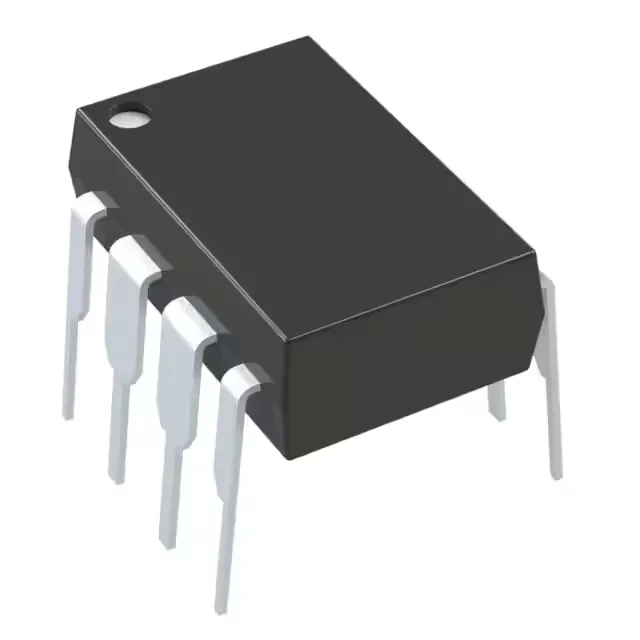
WiperLock™ digital pot for set-and-forget calibration
The MCP4141-103E/P is a single-channel digital potentiometer from Microchip's WiperLock™ series, offering 129 wiper taps across a 10 kΩ resistive element with a linear taper. The non-volatile memory stores the wiper position at power-off, so the calibration value is present on the next power-up — no host reload required after a brownout or reset cycle. This makes it a fit for bias trimming, offset nulling, or volume control in systems where the microcontroller is not always running.
SPI control and 129-tap resolution
The SPI interface writes the wiper register directly — no up/down counter, no pulse-train timing to manage. With 129 taps, the step size on a 10 kΩ part is roughly 78 Ω per tap, giving finer granularity than a 64-tap device for the same resistance range. The wiper resistance is 75 Ω typical, which adds a fixed series offset at the wiper terminal; account for this when the wiper drives a low-impedance load directly.
Through-hole DIP-8 for prototyping and low-volume production
The 8-pin PDIP package is a through-hole footprint that fits standard 0.300-inch-wide sockets. For a bench prototype or a low-volume board that avoids SMT assembly, this package is straightforward to hand-solder and rework. The tolerance is ±20%, which is typical for semiconductor pots — the end-to-end resistance can vary from 8 kΩ to 12 kΩ, but the ratiometric divider accuracy (tap-to-end) is much tighter because it depends on the internal resistor matching, not the absolute value.
Sourcing posture
The active lifecycle means there is no supply discontinuity risk from an imminent EOL, and the standard PDIP package has broad second-source compatibility for socket-fit alternatives.