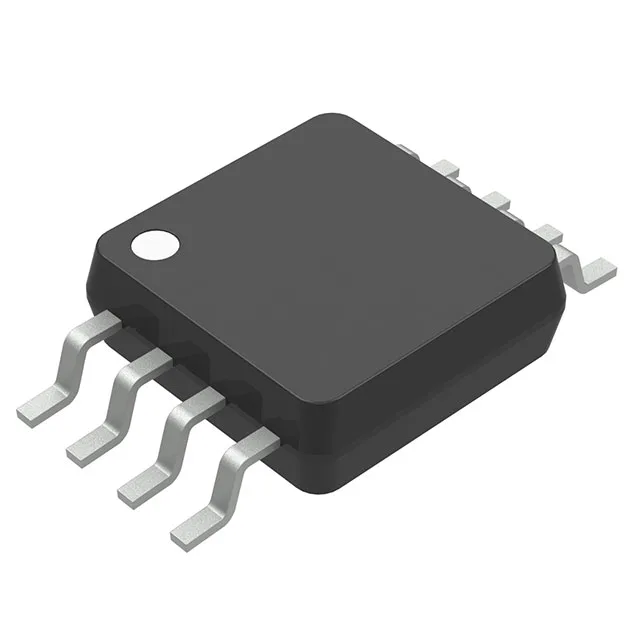
64-tap non-volatile digipot in an 8-MSOP
The MCP4021-502E/MS is a single-channel digital potentiometer from Microchip's WiperLock™ series, configured as a linear-taper potentiometer with 64 wiper tap positions across a 5 kΩ resistor string. The wiper setting is stored in non-volatile memory, so the resistance value at power-up is the last programmed position — no external EEPROM or microcontroller re-initialization needed on each boot. The 64 taps give a resolution of roughly 78 Ω per step (5 kΩ / 64), adequate for trimming bias voltages, setting comparator thresholds, or calibrating sensor offsets in industrial and automotive circuits. The 8-MSOP package (3.00 mm body width) fits tight PCB layouts where a mechanical trimmer would take up three times the board area.
The -40°C to +125°C operating temperature range qualifies it for under-hood automotive, industrial motor-drive enclosures, and outdoor telecom gear — the 150 ppm/°C temperature coefficient on the resistor string keeps the wiper voltage stable across the thermal swing. The wiper resistance is 70 Ω typical, which matters when the pot is used as a voltage divider driving a high-impedance ADC input — the voltage drop across the wiper is negligible. In rheostat mode the 70 Ω adds to the end-to-end resistance, so the minimum achievable resistance is 70 Ω, not zero.
Up/Down interface — no SPI or I²C overhead
The digital interface is a simple Up/Down (U/D, CS) two-wire protocol — no SPI clock or I²C address configuration needed. A chip-select pulse latches the direction, and subsequent pulses increment or decrement the wiper. This keeps the firmware footprint small and frees up the MCU's serial peripheral for other devices. Because the wiper position is non-volatile, the part powers up at the last setting — useful for applications where the trim value must survive a power cycle without a microcontroller storing the calibration constant. The ±20% resistance tolerance is typical for digital pots; for precision dividers, the absolute accuracy is less critical than the ratiometric match between taps.