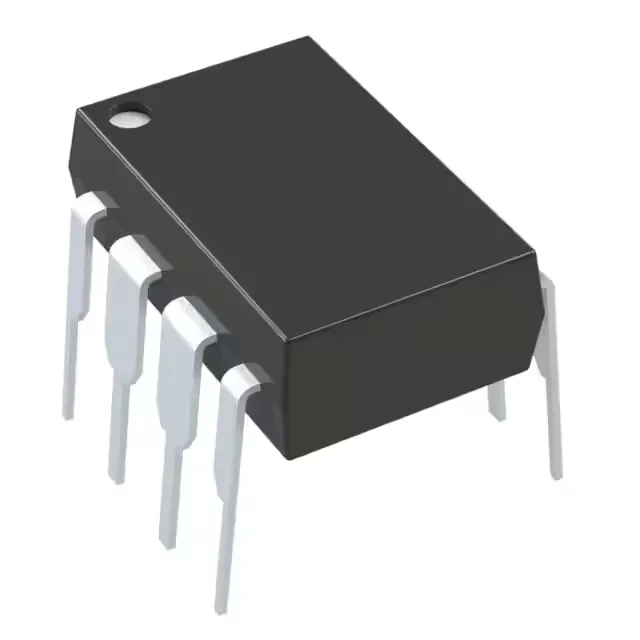
12-bit SAR ADC with a breadboard-friendly DIP footprint
The MCP3201-CI/P is a 12-bit successive-approximation (SAR) ADC from Microchip Technology that samples at 100k samples per second over an SPI bus — fast enough for most sensor readouts, audio capture, or control-loop feedback in a microcontroller project. It runs on a single 2.7V to 5.5V supply (both analog and digital rails share the same range), so it fits comfortably in a 3.3V or 5V system without needing a separate reference rail — just one external voltage reference for the conversion span. The 8-pin DIP package (0.300" width, 7.62mm pitch) is the kind you can drop into a breadboard or perfboard and hand-solder in a few minutes — no hot-air station or fine-pitch work required.
What the pseudo-differential input means on your bench
Pseudo-differential input means the ADC measures the voltage on the IN+ pin relative to the IN- pin, but IN- is typically tied to a fixed reference (often analog ground) rather than driven by a separate signal — it rejects common-mode noise on the signal pair better than a true single-ended input, without needing a fully differential front end. For a single sensor reading, you connect the sensor output to IN+ and ground IN- to the same analog ground plane — the 1:1 S/H-to-ADC ratio means each sample is a fresh conversion with no pipeline delay, so the output at the SPI bus is the current reading, not a delayed one.