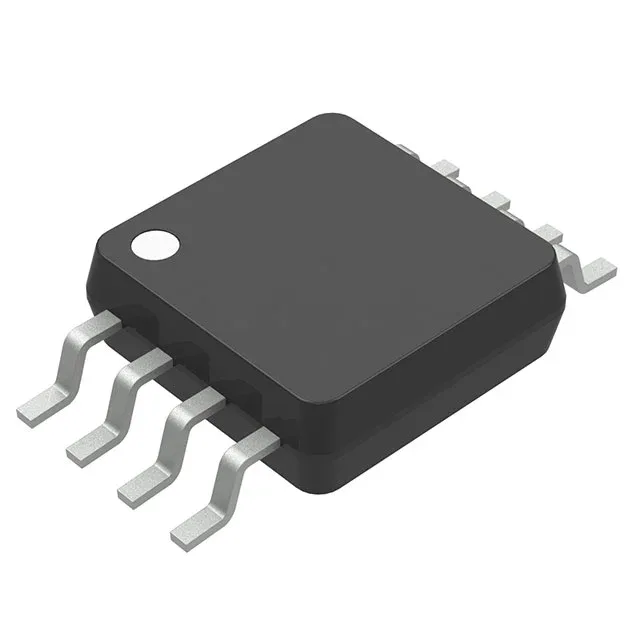
A controller that handles multiple topologies — one BOM line for different power stages
The Microchip MCP1630V-E/MS is a current-mode PWM controller that can be configured for step-up, step-down, or step-up/step-down conversion, covering buck, boost, buck-boost, flyback, and SEPIC topologies. The single output drives an external transistor pair, and the built-in synchronous rectifier support helps keep conduction losses down in low-output-voltage designs.
Supply range and topology — what drives the BOM decision
The 3V to 5.5V Vcc range means this controller runs from a regulated 3.3V or 5V rail — not directly from a battery stack or a rectified line. If your system already has a 3.3V or 5V bias supply, the MCP1630V-E/MS fits without an extra pre-regulator. The topology flexibility (buck, boost, buck-boost, flyback, SEPIC) is the main reason to standardise on this part across multiple power stages: one controller type for the 5V-to-3.3V buck, the 5V-to-12V boost, and the isolated flyback for the secondary side. That cuts the BOM line count and the qualification overhead.
Synchronous rectification — efficiency lever for low-voltage rails
The MCP1630V-E/MS supports synchronous rectification, which replaces the output Schottky with a second MOSFET. In a 3.3V-output buck, the rectifier MOSFET's lower forward drop can gain a couple of percent efficiency — meaningful when the load is several amps or the enclosure is sealed. The controller drives both the main switch and the synchronous switch, so the external gate-drive circuitry is minimal.
Package and mounting — 8-MSOP with tube delivery
The supplier device package is 8-MSOP. For larger volumes, check whether the reel option (MCP1630V-E/MF or similar) fits your pick-and-place flow better.
For a new-design BOM, this part is a low-risk line — no imminent obsolescence to plan around.