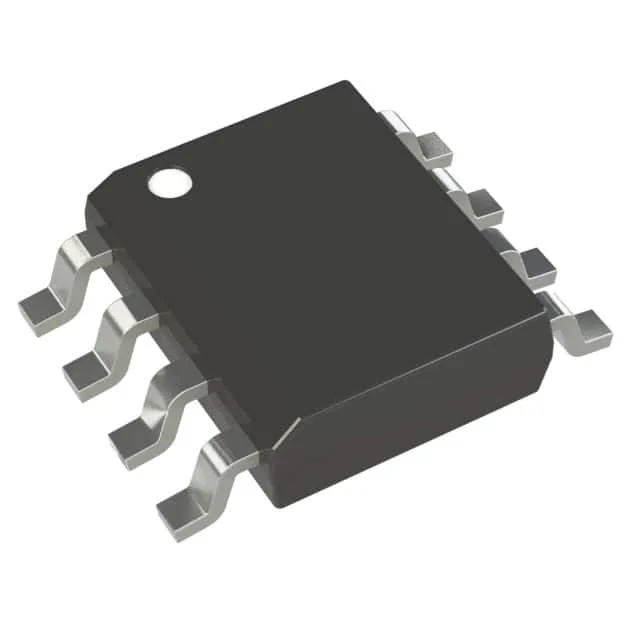
Precision 4.096V reference for ADC signal chains
The MCP1501T-40E/SN is a Microchip Technology series voltage reference delivering a fixed 4.096V output with ±0.1% initial accuracy. That 4.096V level maps directly to the full-scale input range of many 12-bit and 16-bit successive-approximation ADCs — no resistive divider to scale the reference, no gain error from an external scaling network. The series reference topology draws 550 µA quiescent supply current and can source up to 20 mA to the load. For a precision ADC reference input that typically draws 1–5 mA, the 20 mA budget leaves margin to drive multiple converter channels or an external buffer without loading the reference output.
Temperature drift and noise floor — the error budget drivers
The 50 ppm/°C temperature coefficient means the output voltage shifts by 205 µV for every 1°C change. For a design that needs 14-bit effective resolution across temperature, a system-level calibration or a lower-drift reference is worth evaluating. This 1/f noise floor sets the practical limit for DC measurements — any signal below that noise amplitude is indistinguishable from the reference's own flicker noise. The broadband noise spec of 110 µVrms from 10 Hz to 10 kHz matters less for DC accuracy but can alias into a fast-sampling ADC if the reference output is not decoupled properly at the converter's reference pin.
Input headroom and supply requirements
The input voltage range is 4.3V to 5.5V. With a 4.096V output, the minimum dropout is just 204 mV — typical for a series reference. If the upstream rail is a 5V ±5% supply, the lowest input at 4.75V still leaves 654 mV of headroom, well within the operating envelope. Below 4.3V the reference drops out of regulation and the output follows the input minus the pass transistor drop. No special land pattern or via-in-pad required — a generic SOIC-8 footprint on a two-layer board is sufficient.
Active lifecycle and compliance status
For a BOM that needs a stable reference source across a multi-year production run, this part does not introduce end-of-life risk.