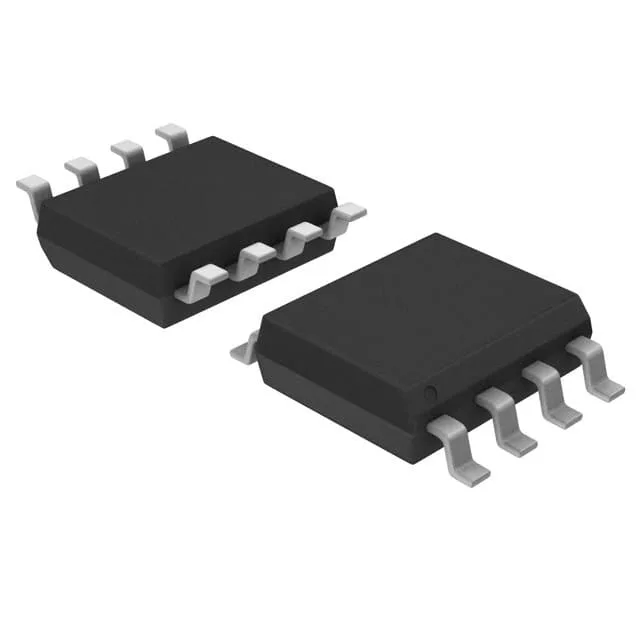
What this EL driver does on a backlight board
The HV830LG-G is a dedicated EL (electroluminescent) lamp driver from Microchip Technology — not a general-purpose inverter, but a part designed to drive the capacitive load of an EL panel at its resonant frequency. It generates a high-voltage AC waveform from a low-voltage DC supply, typically 2V to 9.5V, stepping it up to the 100-200 Vpp range needed to excite the phosphor layer in an EL lamp. The output oscillates between 55 kHz and 75 kHz, which is where most EL panels exhibit their peak brightness-to-voltage efficiency. Driving outside that band means you either need more voltage for the same luminance or the lamp life takes a hit from dielectric stress. Quiescent supply current is 100 µA — low enough that the driver itself doesn't drain a battery faster than the EL panel's own leakage. This matters for portable devices where the backlight runs intermittently and the driver stays biased between active intervals.
Package, supply, and temperature — the fit check
Supply range spans 2V to 9.5V, covering a single-cell Li-ion (3.0-4.2V) or two alkaline cells in series (2.4-3.2V under load). The upper end accommodates a 9V battery or a regulated 5V rail with headroom. Operating temperature is -25°C to 85°C, which covers indoor consumer gear and most industrial enclosures but not under-hood automotive or outdoor pole-mount equipment. If your EL panel sits in a freezer or a hot warehouse, the driver's temp range is the constraint, not the panel's.
Active lifecycle and compliance — no LTB clock ticking
Because it is active and not niche-obsolete, supply is straightforward through authorized distribution.