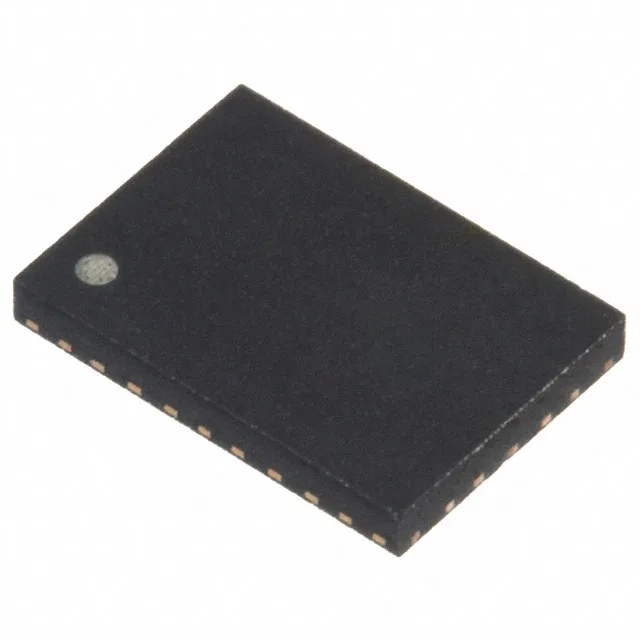
MEMS oscillator with LVPECL output and automotive-grade qualification
The DSC8102AI5: That qualification makes it suitable for engine-adjacent or chassis-mounted timing where the ambient sees 85°C and the vibration spectrum is non-trivial.
The LVPECL output common-mode voltage shifts with VDD, so the AC-coupled termination at the receiver must track the supply; a 2.5 V rail sets the VOH/VOL levels lower than a 3.3 V rail, but the differential swing remains within the LVPECL input window of the downstream FPGA or SerDes. The standby function (pin-controlled) cuts the core oscillator and output buffer, dropping current to the microamp range — useful for power-cycled modules that must wake to a stable clock within the MEMS startup time (typically under 5 ms, versus tens of ms for a quartz oscillator with a large load cap). Total frequency stability is ±10 ppm, which includes initial accuracy, temperature drift, supply sensitivity, and aging over the rated life. For a 100 MHz reference, that is ±1 kHz absolute — tight enough for 1 GbE or SATA reference clocks without external VCXO trimming.
Package and board integration
The 6-pin footprint is standard for this class of MEMS oscillator — pin 1 is standby, pin 2 is ground, pin 3 is output, pin 4 is complementary output, pin 5 is no-connect, and pin 6 is VDD. X-ray inspection confirms the joint, not visual. The part ships in tube packaging (not tape-and-reel), so it arrives in anti-static tubes with the pins aligned.
Sourcing and compliance posture
The base product number is DSC8102, meaning the same die and package serve multiple frequency/output variants. The blank-programmable ordering option means the DSC8102AI5 ships without a factory-programmed frequency — the user programs it via Microchip's TimeFlash or a compatible programmer before assembly. This is a design-in consideration: the blank part must be programmed before reflow, or a pre-programmed variant (DSC8102xx) should be ordered for production.