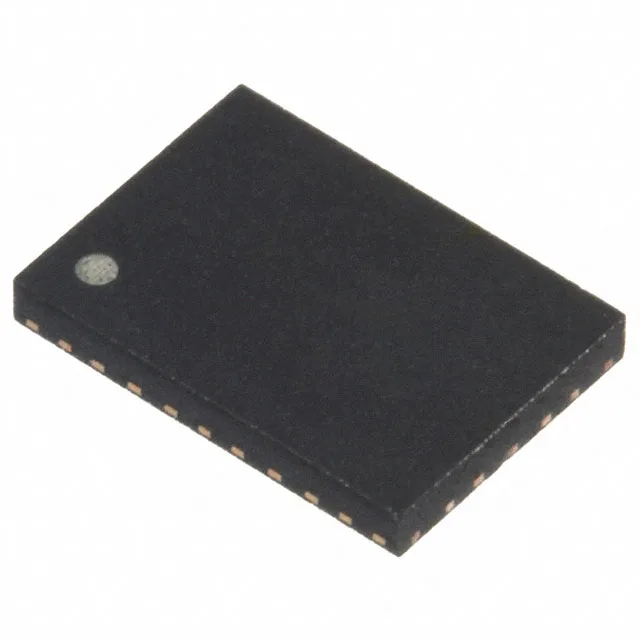
Active production status and BOM-fit note
The DSC8102AI2: Because the part is factory-programmable (Blank, User Must Program), the unprogrammed device ships from stock and the frequency is set during board-level assembly via Microchip's programming tools. This avoids the lead-time penalty of factory-programmed variants when the volume justifies the programming step.
The LVPECL output delivers a differential swing of roughly 1.6 V to 3.6 V into a 50-Ω terminated line, which is the standard interface for high-speed SERDES reference clocks, Ethernet PHY XTAL inputs, and FPGA/SoC clock inputs that expect a differential signal. The differential nature rejects common-mode supply noise on the PCB trace, so the phase-noise floor at the receiver stays close to the oscillator's own noise profile. Frequency range spans 10 MHz to 460 MHz, which covers the common reference rates for 100/1000BASE-T Ethernet, PCIe Gen 1/2/3 reference clocks, and many ARM Cortex-A processor core PLL inputs.
Automotive qualification and package footprint
AEC-Q100 qualification means the part has passed the full automotive stress suite: temperature cycling, high-temperature storage, moisture sensitivity, and ESD robustness per JEDEC.