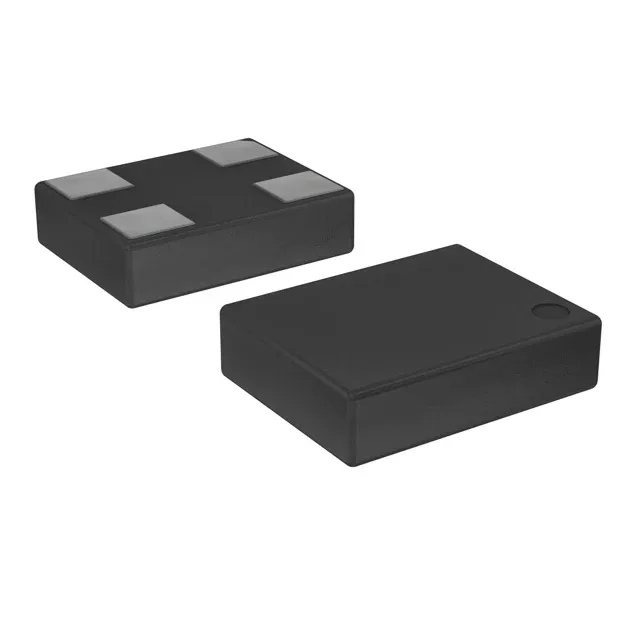
Obsolete MEMS oscillator — sourcing reality
The DSC6112CI2A-000.0000: For a BOM that requires this specific MEMS XO, the procurement path is spot-market sourcing. The part carries AEC-Q100 qualification, which adds traceability value for automotive-grade applications — a broker lot with full date-code and test-data traceability is the preferred buy.
MEMS resonator, CMOS output, wide supply range
This is a MEMS-based standard XO with CMOS output, covering a programmable frequency range of 1 MHz to 100 MHz. The part is a blank (user-programmable) device — it ships without a factory-set frequency. The end user must program it using Microchip's programming tools before the oscillator produces a clock output. This distinguishes it from fixed-frequency variants in the DSC61XX family. For a 100 MHz clock, this translates to a worst-case drift of ±2.5 kHz — within tolerance for most MCU and FPGA reference inputs but worth verifying against the system's PLL jitter budget.
AEC-Q100 and industrial temperature grade
The standby function pulls the disable current down to 12 µA max, enabling battery-preserving sleep modes in always-on automotive systems.
Power budget and standby operation
Active supply current is 3 mA typical at the rated output load — a low figure for a MEMS oscillator, keeping the thermal contribution negligible in a dense layout. The standby function is a logic-controlled power-down — the output goes high-impedance, not a fixed logic level. Downstream logic must account for the floating input during standby to avoid crowbar current or metastable states.