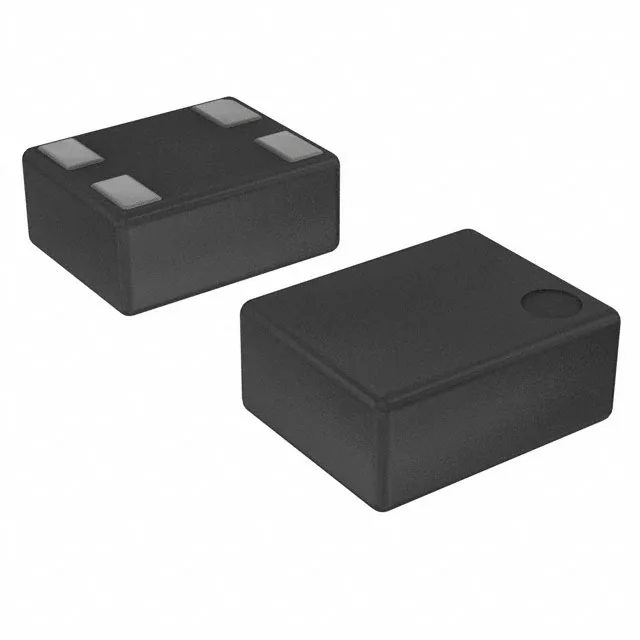
The DSC6102ME2A-000.0000T: That rating is the main reason to pick this over a commercial-grade oscillator — it is specced for the reliability demands of an automotive ECU or a powertrain control module.
Supply flexibility and output compatibility
The CMOS output swings rail-to-rail and drives standard digital inputs directly — no level translation needed at the clock pin. Typical supply current is 3 mA max, which is low enough for battery-powered or always-on modules where the oscillator runs continuously.
Frequency stability and programmable range
That holds the clock edge jitter tight enough for a 100 MHz CMOS bus — the timing margin at the receiver is dominated by the PCB trace skew, not the oscillator drift. The part is blank-programmable over 1 MHz to 100 MHz, meaning the factory ships it unprogrammed and the user sets the output frequency at programming. The -000.0000T suffix indicates the blank (unprogrammed) variant — the actual frequency is written during the board-level programming step.
Obsolete — sourcing through independent channels
For a BOM that already qualifies this part, the procurement path is a spot buy against the remaining inventory in the channel. A new design should migrate to a current-production MEMS oscillator from the same DSC61XX family — the package, supply, and output type are common across the series, but pin compatibility must be verified against the specific replacement order code.