What the AEC-Q100 grade means on a MEMS oscillator
The DSC6101MA3B-PROG: For a board-level repair tech, that scorch mark on the failed ceramic resonator tells you the thermal cycling killed it — this part is built to survive the under-hood environment where quartz cans crack. The operating temperature range spans -40°C to 125°C, covering the full automotive temperature grade 1 envelope. A cold-crank at -30°C and a summer engine bay at 105°C both sit inside the rated window with margin.
Blank-programmable frequency flexibility
This is a blank (user-programmable) device, not a pre-programmed fixed-frequency oscillator. You program the output frequency anywhere in the 3.5 kHz to 100 MHz range using Microchip's programming toolchain. For a 100 MHz clock, that is ±2 kHz of absolute jitter budget — tight enough for a CAN-FD or 100BASE-T1 PHY reference, but not tight enough for a precision GPS PPS holdover.
Supply rail and power budget
The typical supply current is 3 mA — at 3.3 V that is 10 mW of oscillator power, negligible in a 5 W ECU but worth noting in a battery-powered sensor module that sleeps 99% of the time. This is the standard way to save standby power without losing the PLL lock time.
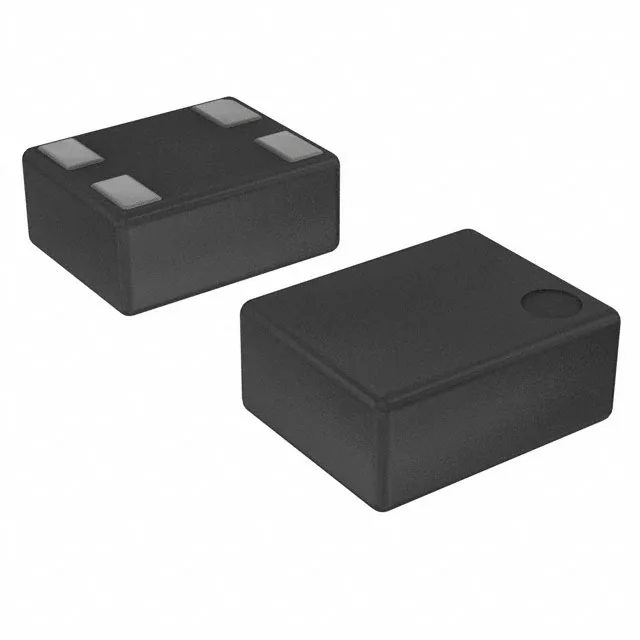
Surface-mount mounting — the VFLGA pads are on the bottom face. A hot-air rework station with a 5 mm nozzle at 300°C for 15 seconds lifts the part cleanly; the solder mask on the board should have a 0.20 mm solder-mask-defined pad to match the LGA land pattern.
Sourcing and lifecycle posture
Sourced through authorized distribution and independent channels. No minimum order quantity applies — single-reel quantities are typical for prototype builds.