MEMS oscillator with AEC-Q100 pedigree
The DSC6101CE2A-000.0000T: Rated AEC-Q100, this part was qualified for automotive-grade reliability stress testing.
Supply and power profile
Typical current draw is 3 mA max — low enough for battery-powered or power-sensitive designs where every milliamp counts.
Frequency stability and programming
Total frequency stability is ±25 ppm, covering temperature, supply voltage, and aging. This is adequate for most digital clocking — MCU cores, USB interfaces, Ethernet PHYs — but not tight enough for precision timing like GPS or wireless baseband where ±10 ppm or better is typical. This is a blank (unprogrammed) device — the user must program the target frequency into the MEMS oscillator before use, either at the factory or with an in-system programming tool. The available frequency range is 1 MHz to 100 MHz.
Package and board-fit
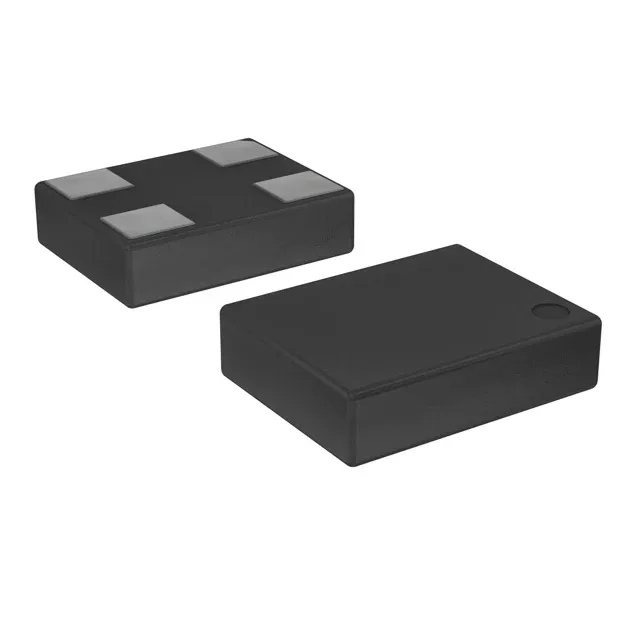
The four-pad layout is the standard oscillator footprint — pin 1 is Enable/Disable, pin 2 is ground, pin 3 is output, pin 4 is supply. No hidden thermal pad underneath, so it reflows cleanly with hot air and the orientation mark is clear on the top of the package.
For new designs, look at Microchip's current DSC61XX family offerings — the active parts in this series share the same MEMS resonator technology, CMOS output, and 4-SMD package, but the exact blank-programmable ordering code has been discontinued. Confirm the BOM position and supply voltage before specifying an alternative.