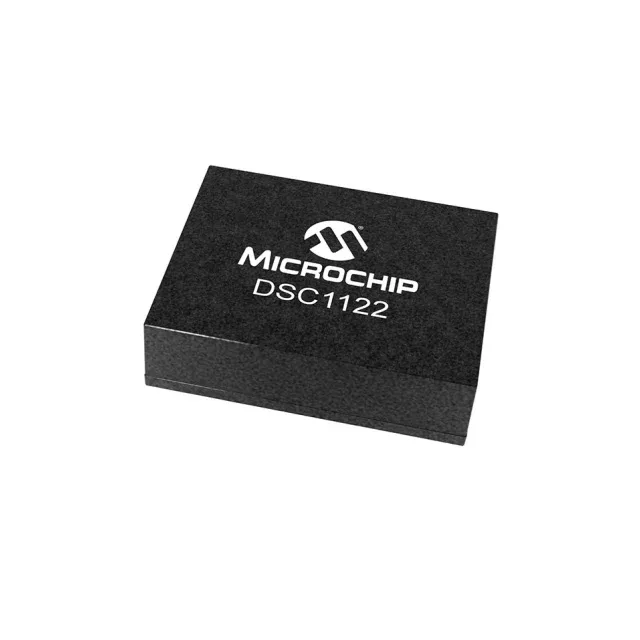
32 MHz clock source qualified for underhood temperature
The DSC6011JI2B-032.0000T: For an engine-bay ECU or a transmission control module that sees 85°C ambient, this is the qualified temperature band, not a marketing claim. Frequency stability is held to ±25 ppm across the operating range, which is tight enough for a CAN bus or FlexRay reference clock without needing an external trim capacitor.
Power budget and standby behaviour
In a battery-backed ECU that sleeps most of the time, the standby (power-down) current drops to 1.5 µA typical, which keeps the quiescent draw below the self-discharge rate of a small coin cell. The standby function is controlled by a dedicated pin; when asserted, the output goes high-impedance and the internal oscillator stops. This means the downstream logic can power-gate the clock without a discrete load switch.
The 4-pin land pattern is standard for 2.5 x 2.0 mm MEMS oscillators — the centre pad is a mechanical support, not a thermal or ground connection, so the PCB fan-out is straightforward on a two-layer board. Surface-mount assembly with Tape & Reel packaging (standard 7-inch reel, 1000 or 3000 pieces depending on the suffix) means it feeds into a pick-and-place line without a reel change.
Sourcing and compliance notes
Production status is active per Microchip's lifecycle record. AEC-Q100 qualification means the part has passed the full automotive stress test suite (preconditioning, temperature cycling, HAST, high-temperature storage, and ESD classification). PPAP documentation is available from Microchip upon request — the OEM auditor will ask for it on a grade-3 part used in a safety- or mission-critical ECU.