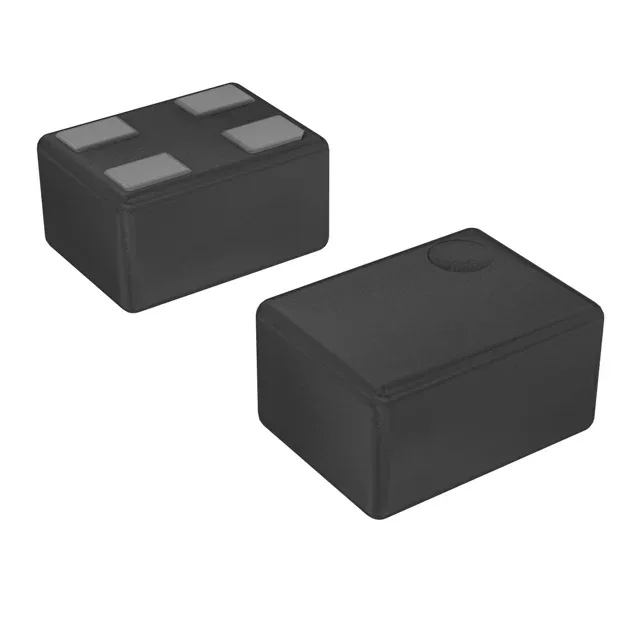
Microchip Technology DSC6003HI2B-048.0000 — Crystals & Oscillators

DSC6003HI2B-048.0000 MEMS XO – 48 MHz, AEC-Q100

MPNDSC6003HI2B-048.0000
Active

Microchip DSC60XXB series, XO (Standard), 48 MHz CMOS output, ±25 ppm stability, AEC-Q100 qualified, 1.8V–3.3V supply, 4-VFLGA package (1.60mm x 1.20mm), Enable/Disable function, -40°C to 85°C operation.

Sourced new & surplus through independent channelsAuthenticity-screened · ESD-safe packingListing updated Aug 2026

Specifications

DSC6003HI2B-048.0000 specifications
ParameterValue
TypeXO (Standard)
SeriesDSC60XXB
MountingSurface Mount
Voltage1.8V ~ 3.3V
Current - supply1.3mA (Typ)
Frequency48 MHz
Frequency stability±25ppm
Operating temperature-40°C~85°C
Size (Dimension)0.063\" L x 0.047\" W (1.60mm x 1.20mm)
Height - seated0.035\" (0.89mm)
OutputCMOS
PackageBag
RatingsAEC-Q100
FunctionEnable/Disable
Base resonatorMEMS
Case4-VFLGA

Product details

Why a MEMS XO beats a quartz crystal here

For an engine-bay ECU or a cabin-domain controller, that qualification is the difference between a one-time boot and 15-year field life.

48 MHz fixed frequency, wide supply, low current

Output is 48 MHz CMOS — a clean rail-to-rail square wave that drives the clock input of most MCUs, SoCs, or CAN transceivers directly. The supply voltage spans 1.8V to 3.3V, so the same part works on a 1.8V core rail or a 3.3V I/O rail without a level shifter. Current draw is 1.3 mA typical at 48 MHz — low enough that a battery-backed real-time clock domain or a sleep-mode wake-up timer can leave the oscillator running continuously without draining the backup capacitor.

4-VFLGA package: board-fit checklist

The 4-VFLGA package measures 1.60 mm x 1.20 mm with a seated height of 0.89 mm — one of the smallest footprints for a 48 MHz oscillator. The land pattern is a 4-pad array with a 0.50 mm pitch; the centre pad is a thermal and mechanical anchor, not an electrical connection. Surface-mount assembly: the VFLGA is a leadless package, so the solder joint is under the part — X-ray inspection is the only way to verify the fillet. The PCB pad design should follow the Microchip recommended land pattern (typically 0.30 mm pad width, 0.65 mm pad pitch) to avoid tombstoning during reflow.

Active production, no end-of-life risk

The DSC60XXB series is Microchip's mainstream automotive MEMS oscillator family, so supply continuity is tied to a high-volume product line.

Frequently asked questions

Is the DSC6003HI2B-048.0000 AEC-Q100 qualified?

Yes — the part carries AEC-Q100 rating. That means it has passed the automotive-grade reliability stress tests: temperature cycling, ESD, latch-up, and high-temperature operating life. It is suitable for under-hood and cabin applications where the ambient temperature range is -40°C to 85°C.

What is the difference between a MEMS oscillator and a quartz crystal oscillator?

A MEMS oscillator (like this DSC6003HI2B-048.0000) uses a silicon MEMS resonator instead of a quartz crystal. MEMS oscillators start faster, are more resistant to shock and vibration, and do not require external load capacitors. The frequency stability (±25 ppm) is comparable to a basic quartz XO, but the MEMS part holds that stability over a wider temperature range without the aging drift of quartz.

Are MEMS oscillators reliable for automotive applications?

Yes — this part is AEC-Q100 qualified, which means it has passed the same reliability tests as automotive-grade ICs. MEMS resonators are inherently more shock-tolerant than quartz crystals, making them a good fit for engine-bay and chassis-mounted modules that see vibration. The operating temperature range of -40°C to 85°C covers the automotive cabin and most under-hood environments.