Why a MEMS oscillator beats quartz for automotive timing
The DSC6003HI2B-025.0000T: This 25 MHz XO uses a MEMS resonator instead of a quartz crystal, which means it survives the 50 g shock and 70,000 g vibration profiles typical of engine-bay and chassis-mounted ECUs without the frequency wander that plagues quartz in those environments. AEC-Q100 qualification confirms it has passed the full automotive stress battery: temperature cycling, moisture sensitivity, and extended life tests.
Current draw that stretches the battery budget
For a telematics unit that stays powered during vehicle sleep, that difference saves 50-100 mAh per year — real battery life on a parked car. The pin is active-low; pulling it high shuts off the output without removing the supply rail.
Package and layout decisions for the 4-VFLGA
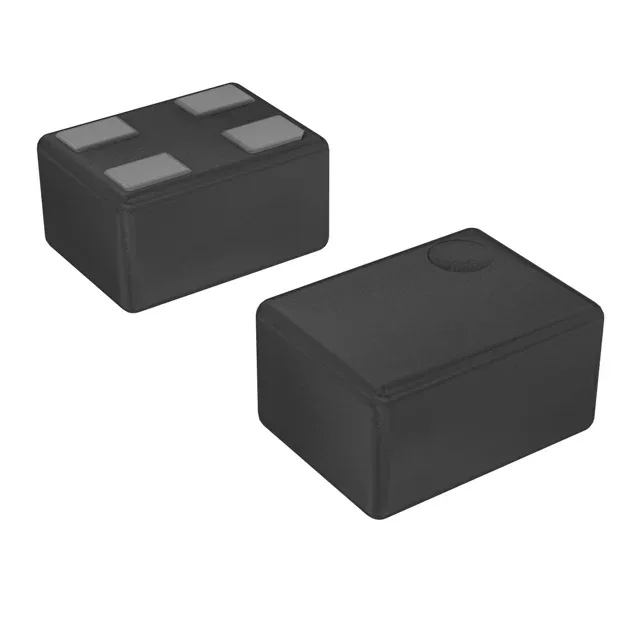
The 1.60 mm x 1.20 mm 4-VFLGA package with 0.89 mm seated height is a compact floorplan for space-constrained PCBs like ADAS camera modules or key-fob sized nodes. The 0.50 mm pitch LGA lands require a solder-mask-defined pad with a 0.25 mm aperture; a 0.10 mm stencil thickness gives a clean solder joint without bridging. Wide supply voltage range 1.8V to 3.3V means the same part can clock a 1.8V MCU core and a 3.3V peripheral bus without a second oscillator line item. Confirm the VIH/VIL thresholds of the receiving device — CMOS output levels track the supply rail, so a 1.8V-fed oscillator outputs 1.8V logic, not 3.3V.
The DSC60XXB series is Microchip's current MEMS oscillator family; no successor has been announced. The DSC6003HI2B-025.0000T is the tape-and-reel variant of the base product number DSC6003.