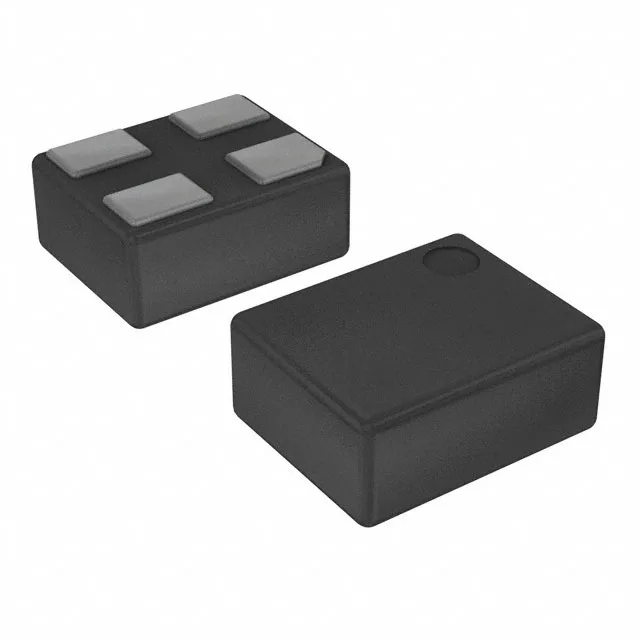
It's a standard oscillator — no PLL, no spread spectrum — just a clean square wave for driving a microcontroller, FPGA, or ASIC clock input. The MEMS resonator means no quartz crystal to age or crack under vibration; the silicon die is the timing element. Runs on any supply from 1.71V to 3.63V, so it can share a 1.8V, 2.5V, or 3.3V rail without a separate LDO. That puts it in the same reliability bracket as the ECU or sensor module it clocks.
No official successor is listed in Microchip's DSC60XX family for this exact 50 MHz, AEC-Q100, 4-pin package variant. A pin-compatible replacement would need to match the 2.00mm x 1.60mm 4-SMD no-lead footprint, the 1.71V–3.63V supply range, and the AEC-Q100 grade — a cross-reference search against other MEMS XO vendors is the practical next step.
Temperature range and package — field-fit check
The 4-SMD no-lead package is a standard 2.00mm x 1.50mm footprint, 0.89mm seated height. No special reflow profile beyond standard lead-free soldering; the MEMS die is less moisture-sensitive than quartz, but standard MSL handling still applies.