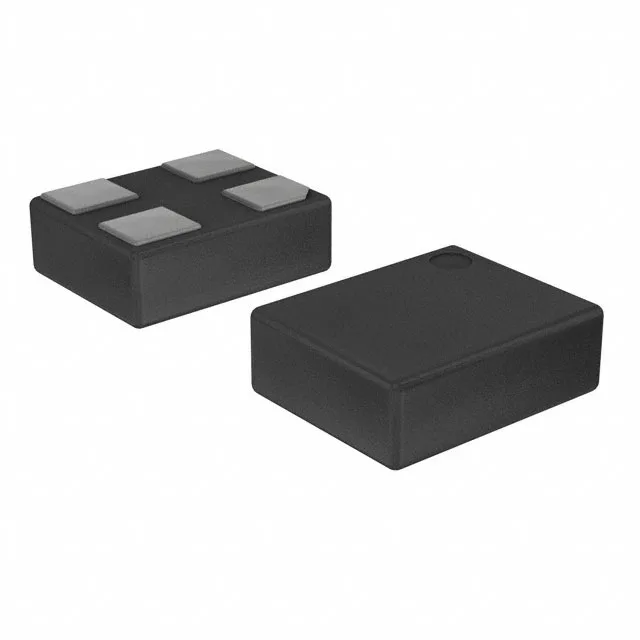
Microchip Technology DSC6001JL3B-025.0000 — Crystals & Oscillators

DSC6001JL3B-025.0000 MEMS Oscillator 25 MHz CMOS AEC-Q100

MPNDSC6001JL3B-025.0000
Active

Microchip Technology DSC6001JL3B-025.0000, XO (Standard), 25 MHz, CMOS output, MEMS resonator, 4-VLGA, -40°C to 105°C, AEC-Q100

Sourced new & surplus through independent channelsAuthenticity-screened · ESD-safe packingListing updated Aug 2026

Specifications

DSC6001JL3B-025.0000 specifications
ParameterValue
TypeXO (Standard)
SeriesDSC60XXB
MountingSurface Mount
Voltage1.71V ~ 3.63V
Current - supply1.3mA (Typ)
Frequency25 MHz
Frequency stability±20ppm
Operating temperature-40°C~105°C
Size (Dimension)0.098\" L x 0.079\" W (2.50mm x 2.00mm)
Height - seated0.035\" (0.89mm)
OutputCMOS
PackageTube
RatingsAEC-Q100
FunctionEnable/Disable
Base resonatorMEMS
Case4-VLGA

Product details

It delivers a CMOS output across a wide supply range of 1.71V to 3.63V, covering both 1.8V and 3.3V logic rails without a secondary regulator — a single supply rail serves the clock tree. For an ECU designer, that is the difference between a part that ships with PPAP documentation and one that requires a waiver from the OEM.

Temperature range and supply tolerance

A cabin-mounted module sees 85°C peak; this oscillator gives 20°C margin before the frequency stability spec of ±20 ppm shifts outside limits. The 1.71V minimum supply ensures it starts from a 1.8V rail that has dropped 90 mV under load — no brown-out at cold crank. In a battery-backed always-on domain controller, that draw is low enough to keep the clock alive during sleep without draining the backup capacitor.

Housed in a 4-VLGA package measuring 2.50 mm x 2.00 mm with a seated height of 0.89 mm. The 4-pin land-grid array is a common MEMS oscillator footprint — it mates with the standard XO land pattern used by Microchip's DSC60XX family and several competitor MEMS oscillators.

Frequently asked questions

Can the DSC6001JL3B-025.0000 run from a 1.8V supply?

Yes. The supply voltage range is 1.71V to 3.63V, so a nominal 1.8V rail is within spec even with 90 mV of dropout. No boost regulator is needed.

How does this MEMS oscillator compare to a standard quartz oscillator?

The DSC6001JL3B-025.0000 uses a MEMS resonator rather than a quartz crystal. MEMS oscillators typically offer better shock and vibration tolerance, faster start-up, and smaller package size — the 2.50 mm x 2.00 mm VLGA is smaller than many quartz counterparts. The trade-off is that quartz can achieve tighter frequency stability over temperature in high-end applications, but the ±20 ppm stability here is adequate for most automotive CAN, LIN, and MCU clock trees.